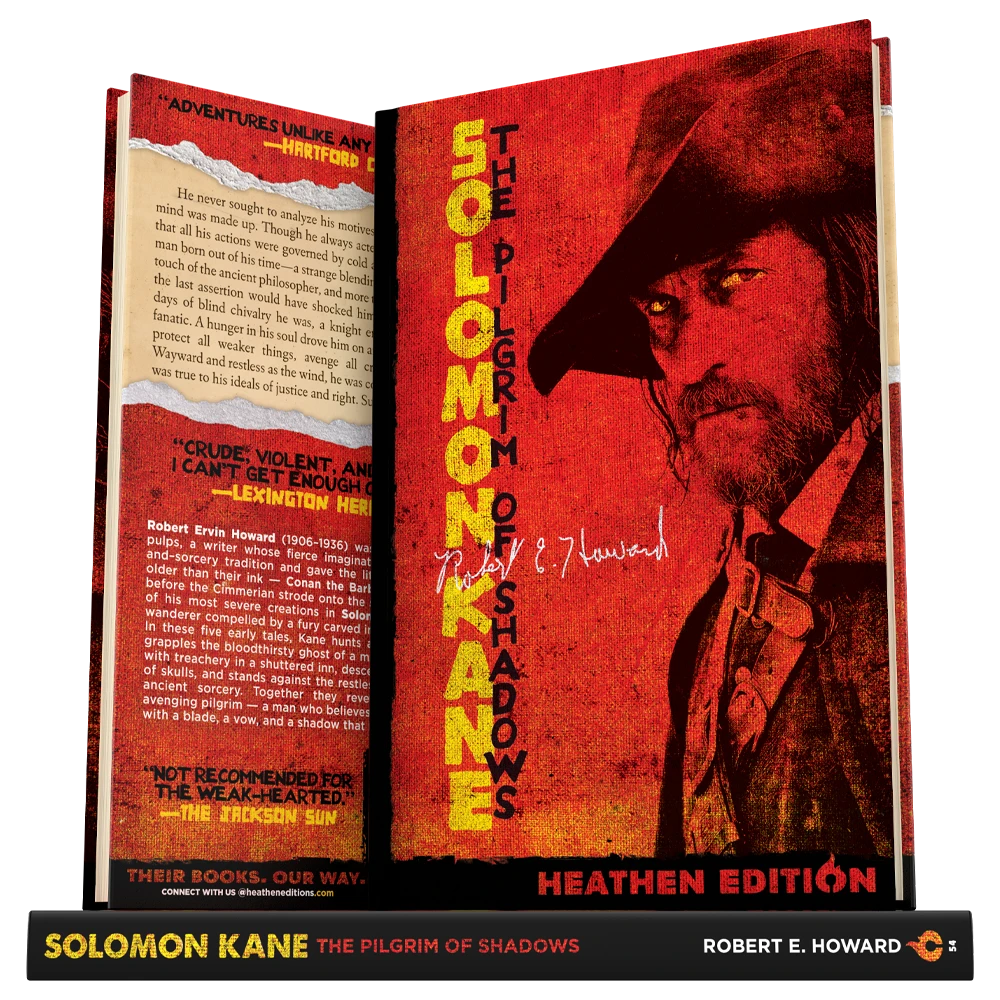
Solomon Kane: The Pilgrim of Shadows
Author
Translator
First Edition
Heathen Edition
Refreshed
Pages
Heathen Genera
Paperback ISBN
Hardcover ISBN
He never sought to analyze his motives and he never wavered, once his mind was made up. Though he always acted on impulse, he firmly believed that all his actions were governed by cold and logical reasonings. He was a man born out of his time—a strange blending of Puritan and Cavalier, with a touch of the ancient philosopher, and more than a touch of the pagan, though the last assertion would have shocked him unspeakably. An atavist of the days of blind chivalry he was, a knight errant in the somber clothes of a fanatic. A hunger in his soul drove him on and on, an urge to right all wrongs, protect all weaker things, avenge all crimes against right and justice. Wayward and restless as the wind, he was consistent in only one respect—he was true to his ideals of justice and right. Such was Solomon Kane.
Robert Ervin Howard (1906–1936) was an American master of the pulps, a writer whose fierce imagination helped forge the sword‑and‑sorcery tradition and gave the literary world figures who feel older than their ink — Conan the Barbarian chief among them. But before the Cimmerian strode onto the stage, Howard introduced one of his most severe creations in Solomon Kane: an ascetic Puritan wanderer compelled by a fury carved into his bones by the Almighty. In these five early tales, Kane hunts a murderer across continents, grapples the bloodthirsty ghost of a murdered lunatic, crosses paths with treachery in a shuttered inn, descends into a forgotten kingdom of skulls, and stands against the restless dead in a land scorched by ancient sorcery. Together they reveal the forging of Howard’s avenging pilgrim — a man who believes himself God’s scourge, armed with a blade, a vow, and a shadow that lengthens with every mile.
With this collection, we present the first five tales of Robert E. Howard’s avenging Puritan, Solomon Kane, arranged in the order they first appeared in the pages of pulp magazine Weird Tales from 1928 to 1930.
Howard later recalled the character’s origins: “Solomon Kane I created when I was in high school, at the age of about sixteen, but . . . several years passed before I put him on paper. He was probably the result of an admiration for a certain type of cold, steely-nerved duelist that existed in the sixteenth century.”
The debut story was originally titled, simply, “Solomon Kane,” and though written with Weird Tales in mind, Howard first tried placing it with Argosy-Allstory in late 1927—the powerhouse pulp that had introduced Tarzan and Zorro and trafficked in adventure, mystery, and fantasy of every stripe.
When Argosy rejected the story, Howard received a long handwritten letter from an associate editor who wanted to give the “why & wherefore, in detail,” and in a letter to a friend, Howard explained that the editor “said in some places the story was ‘very good’ and in some places ‘rotten!’ He says that I have the ‘stuff’ if I ‘get steered right’ so therefore he is giving me the reasons it was turned down . . . He did, very concisely and very clearly . . . the main reason for non sale was ‘unexplained miracles.’”
Roused by the letter’s candor, Howard told that friend, Tevis Clyde Smith, “if a despised weird tale, whose whole minor tone is occultism, can create that much interest with a magazine which never publishes straight weird stuff, I don’t feel so much discouraged.”
Howard then submitted the story to Weird Tales in February 1928, where it was accepted in March—whether for $20 or $80 depends on who’s telling the story—with the only requested change being its title. Thus “Red Shadows” became the cover story for the August 1928 issue, and Solomon Kane was unleashed upon the world.
Kane is unlike nearly any other hero Howard created. Where many of his protagonists swagger through life as brawlers, raiders, or opportunists chasing danger and spoils, Kane moves through the world with a stark moral purpose, dedicating himself to the righting of wrongs. Somber in dress, grim in temperament, and unyielding in conviction, he carries a constant unease about his soul, his worth, and the state of his faith. Within the bounds of adventure‑fantasy, he stands as one of Howard’s most layered—and arguably most believable—figures, more psychologically intricate than several of the later heroes who eclipsed him in popularity.
Those who intimately knew him well recognized the kinship between Howard and his holy avenger, with Clyde Smith observing that Robert “was Solomon Kane, off paper, even more than he was Conan.’’
“Like Kane, he was basically a Puritan. So far from being lawless was he that he would not even cut across other people’s lots, as everyone else did in walking about Cross Plains. Instead he punctiliously strode around the corners of his neighbor’s lawns.”
“Red Shadows” also introduces a recurring character in the Kane universe: N’Longa, the shaman and “pow’rful ju-ju man!”
Ju-ju, for the uninitiated, is the supernatural powers attributed to West African peoples, and N’Longa’s use of “mighty magic” conflicts greatly with Kane’s puritanical faith. N’Longa’s magic being also the “unexplained miracles” that troubled the Argosy-Allstory editor.
Nearly a year after Kane’s debut, the second story, “Skulls in the Stars,” appeared in the January 1929 Weird Tales, heralded as: “Another adventure of Solomon Kane by the author of ‘Red Shadows’—as strange a ghost-tale as was ever penned.”
A third Kane story quickly followed, with “Rattle of Bones” seeing publication in June and introduced thusly: “Solomon Kane, the puritanical Englishman and redresser of wrongs, is trapped in an inn by a murderous landlord.”
Then, the following year, Howard penned a longer Kane tale, “The Moon of Skulls”—the longest of the Kane stories, at 20,000 words—and tried submitting it to MacFadden Publications for inclusion in their pulp magazine Jungle Stories, but after it was rejected, Howard submitted it to Weird Tales, who purchased it for $200 and serialized it in two parts—the first as the June 1930 cover story, the second in July.
And while N’Longa doesn’t make an appearance in those three interim stories, he does return for the fifth and final story that we’ve collected here, “The Hills of the Dead,” which was published in Weird Tales for August 1930.
In total, seven Solomon Kane stories were published in Weird Tales between 1928 and 1932. And across his career, Howard wrote nine Kane stories, three poems, and began but never finished four additional fragments.
For the completists wondering why this volume contains only the first five tales, the answer is simple: copyright confusion. Howard died by suicide in 1936, but the remaining unpublished Kane stories, poems, and fragments were copyrighted posthumously and published in various collections throughout the 1960s. Untangling the present‑day rights situation is maddening, so we’ve chosen to begin with the five stories that raise no legal specters. Rest assured: we fully intend to return to the Kane universe in the future to consummate its Heathen completeness.
Now, as for the text, little editing Heathening has been required on our part given how strikingly modern Howard’s prose already reads. The true bulk of work, therefore, has been in the 170+ footnotes we’ve appended through the text for clarity, context, and commentary where necessary, especially since Howard used many archaic words to stylize his historical fiction.
Additionally, in homage to the originals, we’ve collected the illustrations that accompanied each story in Weird Tales and Heathenized them for use as our title pages in this collection.
Finally, if you’re new to the fiction of Robert E. Howard, then buckle up! These highly charged pulp plots zing like a lit fuse, propelling you skittering and sparking toward one explosive conclusion: THEY’RE. SO. MUCH. FUN.
In the words of the mighty ju-ju man: Ai ya!
“Red Shadows“
“Skulls in the Stars“
“Rattle of Bones“
“The Moon of Skulls“
“The Hills of the Dead“
“In his best work, Howard’s writing seems so highly charged with energy that it nearly gives off sparks.” —Stephen King
“Solomon Kane is a lean, tough 16th century Puritan adventurer who swings a mean rapier. With more couth than Conan, he fights off everything from girls to gorillas. Great stuff for armchair adventurers.” —Jim Roebuck, Edmonton Journal
“Before Stephen King, there was Robert E. Howard, the greatest pulp-fiction writer in the whole wide world.” —Edith Sorenson, The Arizona Daily Star
“The fiction of Robert E. Howard is crude, violent, and implausible. I can’t get enough of the stuff . . . My personal favorite is Solomon Kane, a 17th century Puritan swordsman who believes it is God’s will for him to seek out evil people and carve them into steaks.” —Hiawatha Bray, Lexington Herald-Leader
“‘The Hills of the Dead’ is not recommended for the weak-hearted.” —Danny Walker, The Jackson Sun
“But there’s also no doubt Howard was a genius at conjuring up fantastic worlds populated by muscular evildoers who, faced with Kane’s swinging sword, eventually are reduced to ground round.” —Fort Worth Star-Telegram
“For stark, living fear . . . what other writer is even in the running with Robert E. Howard?” —H.P. Lovecraft
“Kane is not a ‘sympathetic’ figure by today’s literary standards; indeed, his name clearly describes his purpose (Solomon—judge over men; Kane-Cain—a slayer of his fellows) and he is a grim, humorless but nonetheless fascinating character. If we cannot ‘identify’ with him, we can still understand his purpose . . . These are adventures unlike any you’ve ever read, told in a style that sweeps up the reader and carries him along, breathless, to the final (often bloody) lines.” —George W. Earley, Hartford Courant
Solomon Kane: The Pilgrim of Shadows
Heathen Edition #54Published: April 22, 2026
Format: Paperback
- Retail: $12.95
- ISBN-10: 1948316544
- ISBN-13: 9781948316545
- Dimensions: 8.5 x 5.5 x 0.419 inches
- Weight: 8.4 oz
- Retail: $22.95
- ISBN-10: 1963228545
- ISBN-13: 9781963228540
- Dimensions: 8.75 x 5.75 x 0.563 inches
- Weight: 12.4 oz
Interior: Black & White on Creme Paper
Pages: 180 (+2 POD)
Language: English
Annotations: 171 Footnotes
Illustrations: 9
- Title Page
- Heathenry Flame
- Five Title Pages featuring the original Weird Tales artwork
- Honorary Heathen Headshot: Robert E. Howard
- End Title
- Fiction / Fantasy / Dark Fantasy
- Fiction / Occult & Supernatural
- Fiction / Short Stories (single author)