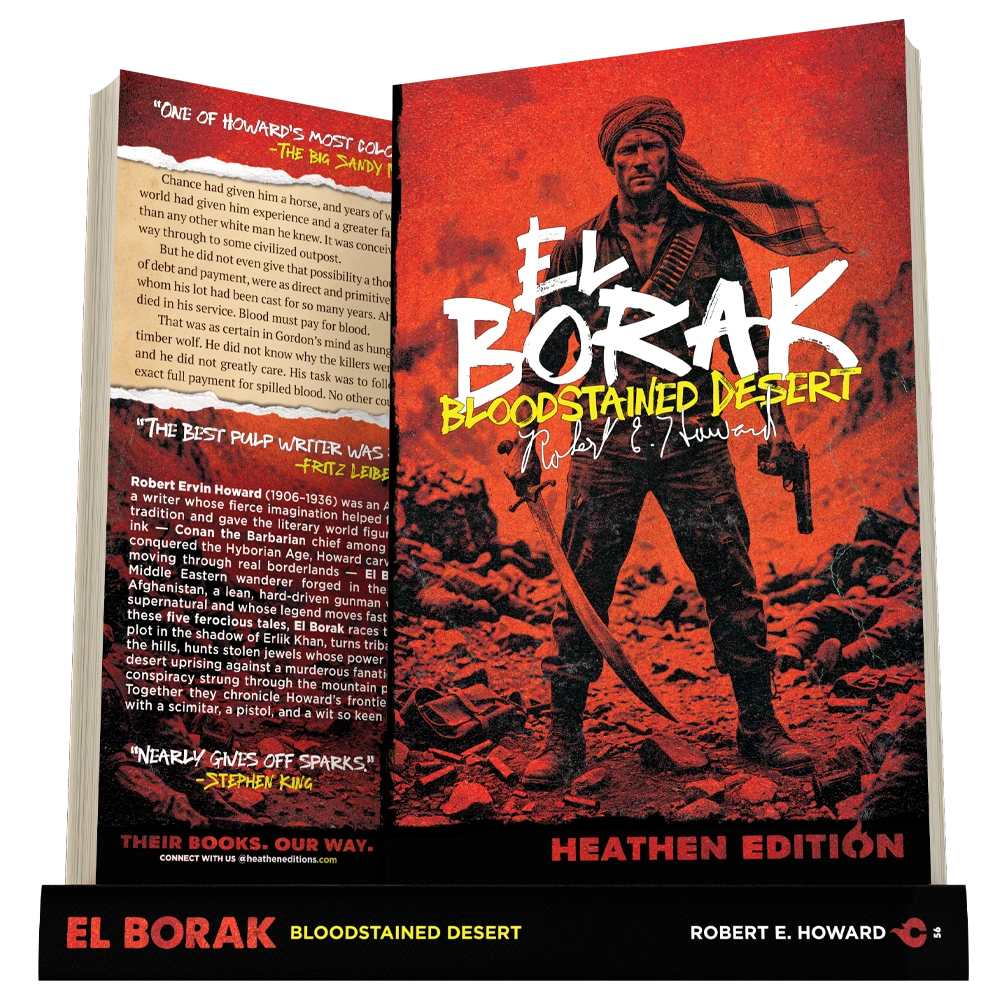
El Borak: Bloodstained Desert
Author
Translator
First Edition
Heathen Edition
Refreshed
Pages
Heathen Genera
Paperback ISBN
Hardcover ISBN
Chance had given him a horse, and years of wandering on the raw edges of the world had given him experience and a greater familiarity with this unknown land than any other white man he knew. It was conceivable that he might live to win his way through to some civilized outpost.
But he did not even give that possibility a thought. Gordon’s ideas of obligation, of debt and payment, were as direct and primitive as those of the barbarians among whom his lot had been cast for so many years. Ahmed had been his friend and had died in his service. Blood must pay for blood.
That was as certain in Gordon’s mind as hunger is certain in the mind of a gray timber wolf. He did not know why the killers were going toward forbidden Yolgan, and he did not greatly care. His task was to follow them to hell if necessary and exact full payment for spilled blood. No other course suggested itself.
Robert Ervin Howard (1906–1936) was an American master of the pulps, a writer whose fierce imagination helped forge the sword–and–sorcery tradition and gave the literary world figures who feel older than their ink — Conan the Barbarian chief among them. While the Cimmerian conquered the Hyborian Age, Howard carved out an explosive creation moving through real borderlands — El Borak, a Texas drifter turned Middle Eastern wanderer forged in the mountains and deserts of Afghanistan, a lean, hard‑driven gunman whose speed borders on the supernatural and whose legend moves faster than the bullets he fires. In these five ferocious tales, El Borak races to stop a warlord’s abduction plot in the shadow of Erlik Khan, turns tribal feuds into battlegrounds in the hills, hunts stolen jewels whose power can ignite a holy war, leads a desert uprising against a murderous fanatic, and cuts his way through a conspiracy strung through the mountain passes like a tripwire in sand. Together they chronicle Howard’s frontier firebrand — a man armed with a scimitar, a pistol, and a wit so keen his infamy is incendiary.
Choose your…
Paperback
OTHER RETAILERS
Rate & Shelve It
Hardcover
Rate & Shelve It
Coming soon . . .
“The Daughter of Erlik Khan“
“Hawk of the Hills“
“Blood of the Gods“
“The Country of the Knife“
“Son of the White Wolf“
“The best pulp writer was Robert E. Howard.” —Fritz Leiber
“One of Robert Howard’s most colorful characters, Francis Gordon — El Borak.” —The Big Sandy News
“Howard’s writing seems so highly charged with energy that it nearly gives off sparks.” —Stephen King
“The art of Robert E. Howard was hard to surpass: vigor, speed, vividness. And always there is that furious, galloping narrative pace.” —Poul Anderson
“For stark, living fear . . . what other writer is even in the running with Robert E. Howard?” —H. P. Lovecraft
“Howard honestly believed the basic truth of the stories he was telling. It’s as if he’d said, ‘This is how life really was lived in those former savage times!’” —David Drake
“For headlong, nonstop adventure and for vivid, even florid, scenery, no one even comes close to Howard.” —Harry Turtledove
“The stories have a livingness about them [that’s] impossible to fake . . . Not one of them is boring — there is always some special touch — and most, of course, are rousers.” —Gahan Wilson
“[Behind Howard’s stories] lurks a dark poetry, and the timeless truth of dreams. That is why these tales have survived. They remain a fitting heritage of the poet and dreamer who was Robert E. Howard.” —Robert Bloch
“Weird, fantastic, but peopled with real men who think and act as we conceive the thoughts and acts of men . . . None of the dummies that pirouette through some stories, using stilted, supposedly archaic language, and moving in response to the author’s obvious string-pulling. All of which leads you to believe that I like it. Correct. I do.” —E. Hoffman Price
El Borak: Bloodstained Desert
Heathen Edition #56Published: 2026
Format: Paperback
- Retail: $19.95
- ISBN-10:
- ISBN-13: 9781948316569
- Dimensions: 8.5 x 5.5 x 0.9 inches
- Weight: x.x oz
- Retail: $29.95
- ISBN-10:
- ISBN-13: 9781963228564
- Dimensions: 8.75 x 5.75 x x.x inches
- Weight: x.x oz
Interior: Black & White on Creme Paper
Pages: 350 (+2 POD)
Language: English
Annotations: xx Footnotes
Illustrations: 9
- Title Page
- Heathenry Flame
- Five Title Pages
- Honorary Heathen Headshot: Robert E. Howard
- End Title
- Fiction /
- Fiction /
- Fiction / Short Stories (single author)