No products in the cart.

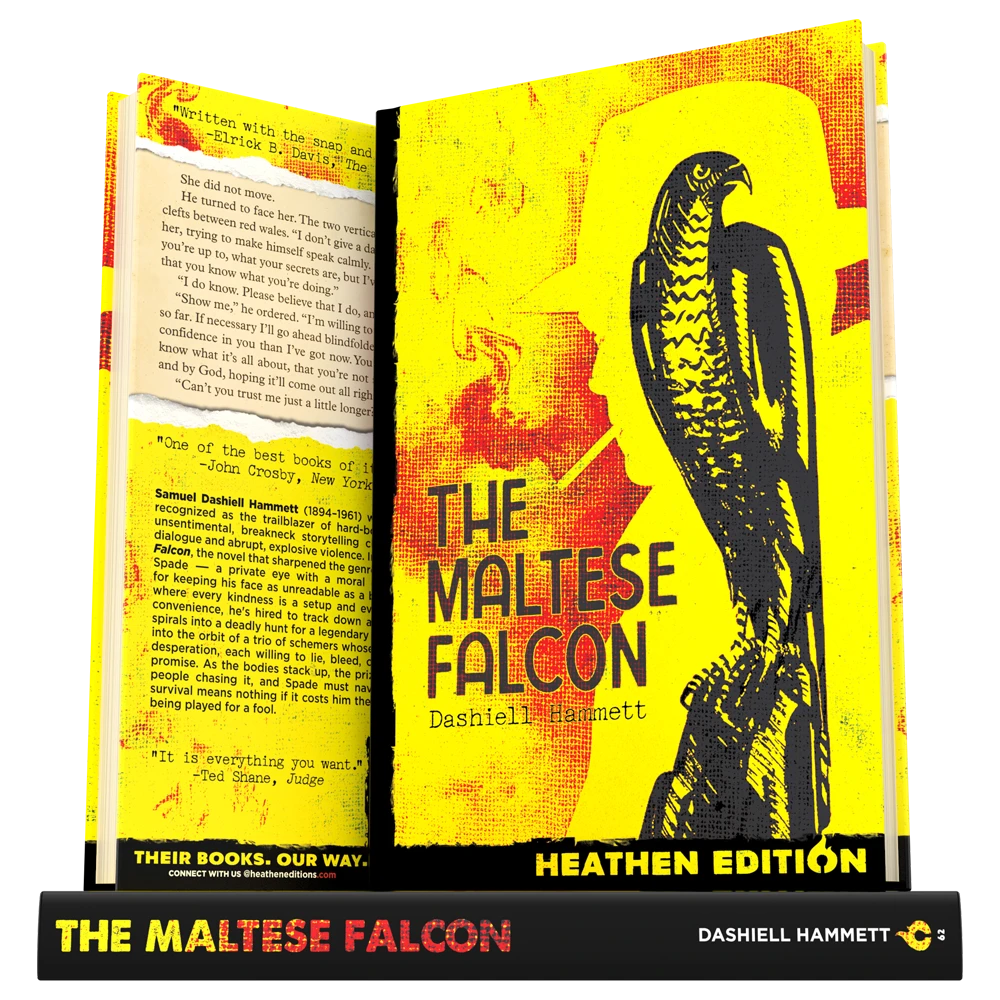
The Maltese Falcon
Spine #62
Author
Dashiell Hammett
Translator
First Edition
February 14, 1930
Heathen Edition
April 5, 2026
Refreshed
Pages
254
Heathen Genera
Wise Guys, eh?
Paperback ISBN
978-1-948316-62-0
Hardcover ISBN
978-1-963228-62-5
She did not move.
He turned to face her. The two vertical lines above his nose were deep clefts between red wales. “I don’t give a damn about your honesty,” he told her, trying to make himself speak calmly. “I don’t care what kind of tricks you’re up to, what your secrets are, but I’ve got to have something to show that you know what you’re doing.”
“I do know. Please believe that I do, and that it’s all for the best, and—”
“Show me,” he ordered. “I’m willing to help you. I’ve done what I could so far. If necessary I’ll go ahead blindfolded, but I can’t do it without more confidence in you than I’ve got now. You’ve got to convince me that you know what it’s all about, that you’re not simply fiddling around by guess and by God, hoping it’ll come out all right somehow in the end.”
“Can’t you trust me just a little longer?”
Samuel Dashiell Hammett (1894–1961) was an American author widely recognized as the trailblazer of hard‑boiled detective fiction with his unsentimental, breakneck storytelling chock‑full of fast‑paced, slangy dialogue and abrupt, explosive violence. In 1930 he published The Maltese Falcon, the novel that sharpened the genre to a lethal point, unveiling Sam Spade — a private eye with a moral code all his own and a talent for keeping his face as unreadable as a blank ledger. In a San Francisco where every kindness is a setup and every partnership is a temporary convenience, he’s hired to track down a missing woman, a search that spirals into a deadly hunt for a legendary falcon statuette, drawing Spade into the orbit of a trio of schemers whose charm is as dangerous as their desperation, each willing to lie, bleed, or kill for a chance to touch its promise. As the bodies stack up, the prize proves as treacherous as the people chasing it, and Spade must navigate a maze of deceit where survival means nothing if it costs him the one thing worse than death — being played for a fool.
Test Your Might
Paperback
OTHER RETAILERS
Rate & Shelve It
Hardcover
OTHER RETAILERS
Rate & Shelve It
"Written with the snap and bite of a whiplash."
Elrick B. Davis
The Cleveland Press
Heathenry
Contents
Praise
Details
Heathenry
Hot on the heels of the success of his first two back-to-back novels featuring his unnamed Continental Op, Red Harvest and The Dain Curse, both released in 1929, Hammett decided to switch main-character gears in 1930 and created in Sam Spade what many argue is the quintessential — if not the authoritative — literary hard-boiled detective.
And while Hammett would later reuse the character in four short stories, so singular is Spade that Hammett only penned one full-length novel featuring him as protagonist: this one.
First serialized in five parts in Black Mask magazine from September 1929 to January 1930, Hammett’s loving gift to pulp enthusiasts, The Maltese Falcon, was released in novel form on Valentine’s Day, February 14, 1930.
In the 1934 rerelease of the book, Hammett said of his creation: “Spade has no original. He is a dream man in the sense that he is what most of the private detectives I worked with would like to have been, and in their cockier moments thought they approached. For your private detective does not — or did not ten years ago when he was my colleague — want to be an erudite solver of riddles in the Sherlock Holmes manner; he wants to be a hard and shifty fellow, able to take care of himself in any situation, able to get the best of anybody he comes in contact with, whether criminal, innocent bystander, or client.”
In an interesting creative choice, if not an *ahem* novel one, Hammett chose to tell this story entirely in external third-person narrative, often called the “camera-eye perspective,” meaning there is a total lack of interiority — there is no description whatsoever of any character’s thoughts or feelings, only what they say and do, and how they look, essentially making the narrator a recording device, capturing only what can be seen or heard — which makes The Maltese Falcon one of the first, if not the first, modern full‑length novels to strictly sustain that point of view throughout.
And, yes, earlier writers did experiment with objective, behavior‑only narration, but mostly in short fiction — Ernest Hemingway’s 1927 short story “The Killers” being but one example — however, Hammett was the first to maintain the discipline cover-to-cover in a novel.
Now, as for the text, we’ve trimmed some hyphenated words so they read a bit easier: good-bye is now goodbye, phone-book has become phonebook, and so on. Inversely, we’ve done the same with words that were once two but are now one: good night is now goodnight — and I’m not sure why Hammett rendered Hongkong as a single word, but we have retrofitted it with its modern usage: Hong Kong.
And, after researching nearly every version of Falcon currently available, I feel confident in saying that our edition is the most annotated version currently in existence, with 200+ footnotes to provide clarity, context, and commentary where necessary, especially due to the many slang terms that Hammett peppers throughout the story.
Additionally, Hammett used several real San Francisco locations in this story, and invented some fictional locations inspired by real locations, so we have been meticulous in identifying if all of those locations still exist today, if they’ve survived as originally identified in the story, or if they have been converted into something else, along with all of the original or current addresses for each, so that, utilizing our footnotes, you can craft your own walking tour (or virtual Google Maps tour) of Hammett’s San Francisco.
Finally, let’s talk cover art: when I first approached this book, I imagined that I would create my own falcon for it — you know, make my mark, sear my signature — but after cycling through myriad falcons, I defaulted to the OG falcon that first appeared on the book’s dust jacket in 1930. There’s just something about that falcon — its style, its attitude — I can’t create one better, so what’s old is new again, which is fitting because old-is-new is the Heathen Editions way!
Sadly, the original art went uncredited and, to this day, no one is quite sure who did the work, but to whomever that artist was, I just want to say: excellent work — for it, like Sam Spade himself, is and will forever be timeless . . .
Sheridan Cleland
Co-Heathen
April 2026
Contents
Heathenry: Thoughts on the Text
The Maltese Falcon
The Maltese Falcon
Praise
“The Maltese Falcon was one of the best books of its kind ever written. It struck the publishing world and the reading world — which is something entirely distinct from the literary world — like a thunderclap. Nothing has been the same since.” —John Crosby, New York Herald Tribune
“A knockout detective is Sam Spade.” —The Boston Globe
“We want to go on record as saying that this story is a marvelous piece of writing — the finest detective story it has ever been our privilege to read in book form, in any magazine of any kind, or in manuscript. Don’t miss it.” —Joseph Shaw, editor of Black Mask
“[Hammett] writes with a lead-pipe and poisoned arrows as coups de grace. He stands alone as ace shocker . . . And now The Maltese Falcon, a button-button-who’s-got-the-falcon? of San Francisco. It is everything you want . . . The writing is better than Hemingway.” —Ted Shane, Judge
“The sheer force of Hammett’s hard, brittle writing lifts the book out of the general run of crime spasms and places it aloof and alone as a brave chronicle of a hard-boiled man, unscrupulous, conscienceless, unique.” —John G. Neihardt, St. Louis Post-Dispatch
“The best detective story America has yet produced.” —Alexander Woolcott
“There are detective-story writers, and then there is Dashiell Hammett. I can think of no one in the world who is his match . . . The book is written with the snap and bite of a whiplash . . . The Maltese Falcon has a thousand virtues, of observation, of detail, of nuance, and of effect.” —Elrick B. Davis, The Cleveland Press
Details
The Maltese Falcon
Heathen Edition #62Published: April 5, 2026
Format: Paperback
- Retail: $14.95
- ISBN-10: 1948316625
- ISBN-13: 9781948316620
- Dimensions: 8.5 x 5.5 x 0.58 inches
- Weight: 11.2 oz
- Retail: $24.95
- ISBN-10: 1963228626
- ISBN-13: 9781963228625
- Dimensions: 8.75 x 5.75 x 0.75 inches
- Weight: 15.5 oz
Interior: Black & White on Cream Paper
Pages: 254 (+2 POD)
Language: English
Annotations: 207 Footnotes
Illustrations: 4
- Title Page
- Heathenry Flame
- Honorary Heathen Headshot: Dashiell Hammett
- End Title
- Fiction / Mystery & Detective / Private Investigators
- Fiction / Mystery & Detective / Hard-Boiled
- Fiction / Crime


The Heathen Newsletter
Want to be kept in the loop about new Heathen books, receive discounts and random cat photos, and unwillingly partake in other tomfoolery? Subscribe to our newsletter! We promise we won’t harass you – much. Also, we require your first name so that we can personalize your emails. ❤️
@heatheneditions #heathenedition
Copyright © 2026 Heathen Creative, LLC. All rights reserved.