No products in the cart.

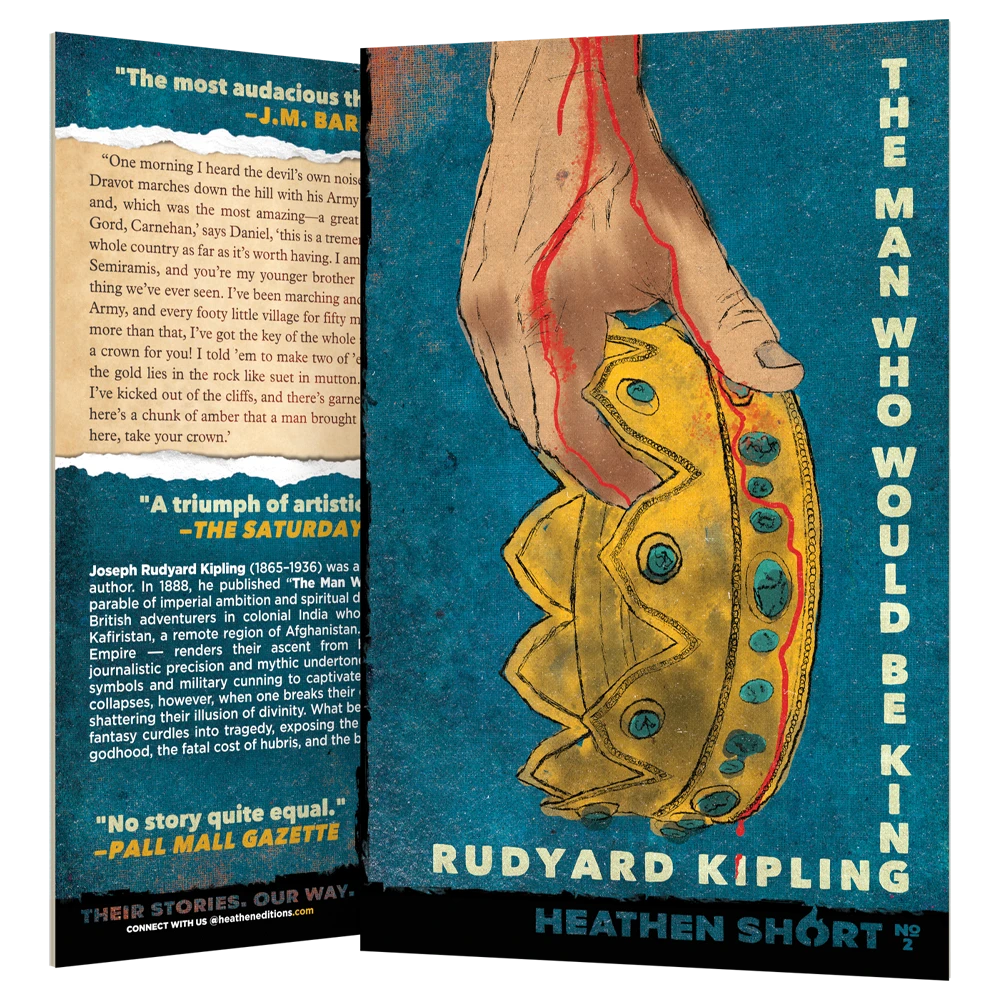
The Man Who Would Be King
Heathen Short #2
Author
Rudyard Kipling
Translator
First Edition
1888
Heathen Short
December 24, 2025
Refreshed
Pages
58
Heathen Genera
Victorian Grit
ISBN
979-8-90075-002-6
“One morning I heard the devil’s own noise of drums and horns, and Dan Dravot marches down the hill with his Army and a tail of hundreds of men, and, which was the most amazing—a great gold crown on his head. ‘My Gord, Carnehan,’ says Daniel, ‘this is a tremenjus business, and we’ve got the whole country as far as it’s worth having. I am the son of Alexander by Queen Semiramis, and you’re my younger brother and a god too! It’s the biggest thing we’ve ever seen. I’ve been marching and fighting for six weeks with the Army, and every footy little village for fifty miles has come in rejoiceful; and more than that, I’ve got the key of the whole show, as you’ll see, and I’ve got a crown for you! I told ’em to make two of ’em at a place called Shu, where the gold lies in the rock like suet in mutton. Gold I’ve seen, and turquoise I’ve kicked out of the cliffs, and there’s garnets in the sands of the river, and here’s a chunk of amber that a man brought me. Call up all the priests and, here, take your crown.’
Joseph Rudyard Kipling (1865–1936) was an English journalist, poet, and author. In 1888, he published “The Man Who Would Be King,” a sharp parable of imperial ambition and spiritual delusion. The story follows two British adventurers in colonial India who crown themselves kings of Kafiristan, a remote region of Afghanistan. Kipling — himself a child of Empire — renders their ascent from beggars to sovereigns with journalistic precision and mythic undertones as they wield Freemasonic symbols and military cunning to captivate a native people. Their reign collapses, however, when one breaks an oath and takes a native bride, shattering their illusion of divinity. What begins as a swaggering colonial fantasy curdles into tragedy, exposing the moral rot beneath self-made godhood, the fatal cost of hubris, and the bitter echo of blasphemy.
Test Your Might
In stock
OTHER RETAILERS
Rate & Shelve It
"Among the very best ever written by Mr. Kipling."
The Independent
Heathenry
Contents
Praise
Details
Heathenry
…as for the text, as per our usual Heathening, we’ve modernized some hyphened words to reflect their current usage: to-day is now today, to-morrow has become tomorrow, and so on.
The real bulk of our work, however, lies in the 130+ footnotes we’ve appended to enhance your reading of the story, and to provide clarity, context, and commentary where necessary, which we believe will render your reading of this rambunctious romp enriching and educational.
Godspeed!
Contents
Heathenry: Thoughts on the Text
Map of Kafiristan
“The Man Who Would Be King“
Map of Kafiristan
“The Man Who Would Be King“
Praise
“The most audacious thing in fiction.” —J.M. Barrie
“One of Rudyard Kipling’s best stories is ‘The Man Who Would Be King.’” —Richmond Times-Dispatch
“Full of wild and brilliant writing.” —The Press
“The way sets forth in ‘The Man Who Would Be King’ has the taste of the real thing . . . it is all more real than imagination could contrive.” —Boston Evening Transcript
“One of his most powerful stories.” —The Evening Chronicle
“There is no story quite equal to ‘The Man Who Would Be King’ for grasp and sweep of imagination.” —Pall Mall Gazette
“Among the very best ever written by Mr. Kipling . . . marked with all his graphic force and dramatic vigor.” —The Independent
“The imaginative power of his incomparable story ‘The Man Who Would Be King’ is a triumph of artistic deception.” —The Saturday Review
“Kipling is the greatest genius we have had for 50 years in imagination, genius, and grip. I think his story, ‘The Man Who Would Be King,’ the finest story in the English language.” —Walter Besant
“Brilliant if exceedingly gruesome . . . one of the strongest bits of work Kipling has ever done.” —The New Zealand Times
“Nothing wilder or more weird was ever written than ‘The Man Who Would Be King’ . . . in which Kipling’s imagination reaches its highest mark.” —San Francisco Chronicle
Details
The Man Who Would Be King
Heathen Short #2Published: December 24, 2025
Format: Paperback
Retail: $7.95
ISBN-13: 9798900750026
Dimensions: 8.5 x 5.5 x 0.15 inches
Weight: 3 oz
Cover: Matte Finish
Interior: Black & White on Cream Paper
Pages: 58 (+2 POD)
Language: English
Annotations: 133 Footnotes
Illustrations: 6
- Title Page
- The Head!
- Heathenry Flame
- Map of Kafiristan
- Honorary Heathen Headshot: Rudyard Kipling
- End Title
- Fiction / Action & Adventure
- Fiction / World Literature / India / 19th Century
- Social Science / Freemasonry & Secret Societies

The Heathen Newsletter
Want to be kept in the loop about new Heathen books, receive discounts and random cat photos, and unwillingly partake in other tomfoolery? Subscribe to our newsletter! We promise we won’t harass you – much. Also, we require your first name so that we can personalize your emails. ❤️
@heatheneditions #heathenedition
Copyright © 2026 Heathen Creative, LLC. All rights reserved.