No products in the cart.

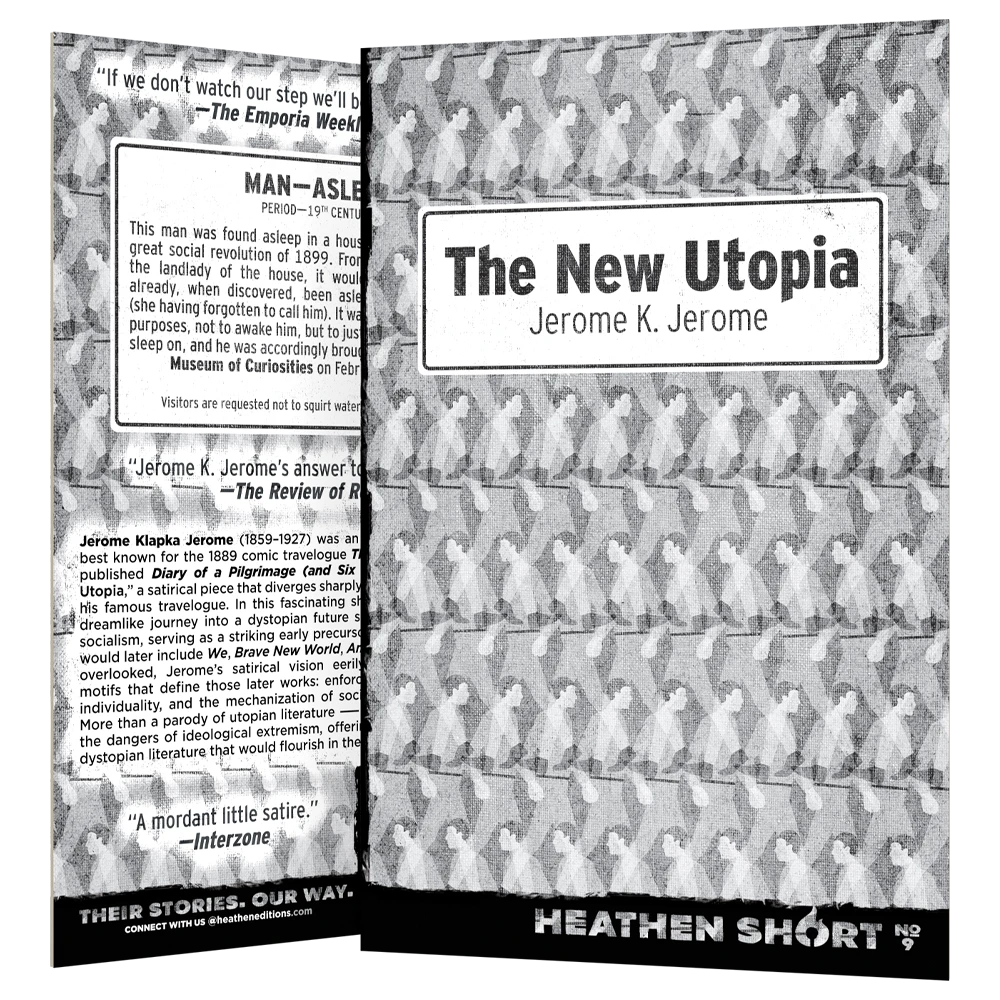
The New Utopia
Heathen Short #9
Author
Jerome K. Jerome
Translator
First Edition
1891
Heathen Short
January 9, 2026
Refreshed
Pages
30
Heathen Genera
Hi-Sci-Fi
ISBN
979-8-90075-009-5
MAN — ASLEEP
Period — 19th Century
This man was found asleep in a house in London, after the great social revolution of 1899. From the account given by the landlady of the house, it would appear that he had already, when discovered, been asleep for over ten years (she having forgotten to call him). It was decided, for scientific purposes, not to awake him, but to just see how long he would sleep on, and he was accordingly brought and deposited in the ‘Museum of Curiosities,’ on February 11th, 1900.Visitors are requested not to squirt water through the air-holes.
Jerome Klapka Jerome (1859–1927) was an English author and humorist, best known for the 1889 comic travelogue Three Men in a Boat. In 1891, he published Diary of a Pilgrimage (and Six Essays), featuring “The New Utopia,” a satirical piece that diverges sharply from the light-hearted tone of his famous travelogue. In this fascinating short story, Jerome imagines a dreamlike journey into a dystopian future shaped by extreme egalitarian socialism, serving as a striking early precursor to the dystopian canon that would later include We, Brave New World, Anthem, and 1984. Though often overlooked, Jerome’s satirical vision eerily anticipates the totalitarian motifs that define those later works: enforced uniformity, suppression of individuality, and the mechanization of society in the name of progress. More than a parody of utopian literature — it’s a pointed commentary on the dangers of ideological extremism, offering a satirical blueprint for the dystopian literature that would flourish in the 20th century.
Test Your Might
In stock
OTHER RETAILERS
Rate & Shelve It
“If we don’t watch our step we’ll be in Jerome’s ‘Utopia.’”
The Emporia Weekly Gazette
Heathenry
Contents
Praise
Details
Heathenry
Jerome K. Jerome, best known for the comic brilliance of his 1889 Three Men in a Boat, was also a sharp satirist with a keen eye for the absurdities of social reform.
In 1891, within Diary of a Pilgrimage (and Six Essays), he published “The New Utopia,” a short, dreamlike excursion into a future governed by extreme egalitarian socialism. The piece stands in deliberate contrast to his lighthearted travel writing, revealing a writer capable of turning his wit toward darker, more speculative ends.
What makes “The New Utopia” remarkable — indeed, indispensable — is how clearly it anticipates the dystopian tradition that would not fully bloom until decades later.
Long before WE, Brave New World, Anthem, or 1984, Jerome was already sketching the architecture of totalitarian modernity: enforced sameness, the erasure of individuality, the bureaucratic management of life, and the chilling belief that progress requires the sacrifice of the human spirit.
These motifs, which later became hallmarks of the genre, appear here in embryonic but unmistakable form. If we are to talk seriously about the lineage of dystopian fiction — if we invoke Zamyatin, Huxley, Rand, or Orwell — then we must begin with Jerome.
“The New Utopia” is not merely a parody of utopian excess; it is an early warning, a satirical blueprint, and a foundational text in the evolution of the modern dystopia. To overlook it is to misunderstand the genealogy of the genre itself.
To read it now is to watch the genre’s future taking shape in real time. Jerome approaches dystopia not with the solemnity that later writers would adopt, but with a humorist’s scalpel — precise, unsparing, and all the more devastating for its lightness of touch. His satire exposes the same authoritarian impulses that would later be rendered in darker hues, proving that the DNA of modern dystopian fiction was already present in the 1890s.
“The New Utopia” reminds us that the conversation about dystopia did not begin in the 20th century; Jerome deserves to be recognized as one of the foundational architects of the literary dystopian tradition, and it’s long past time we said so plainly. That’s why we’ve created this Short: we believe the piece stands on its own as a fully independent work — compact, incisive, and more than worthy of its place in the canon, even if it is just shy of a couple dozen pages.
As for the text, given its brief page count there was little editing Heathening required of us, but we’ve modernized a few hyphenated words so they read a bit easier (to-day is now today, and so on). We’ve also appended twenty footnotes throughout the story to provide clarity, context, and commentary where necessary.
Additionally, we have included Jerome’s preface from Diary of a Pilgrimage, lightly edited to remove references to the book’s other essays. Our aim is to orient you to Jerome’s intention and, if you’re not familiar, introduce you to his signature wink‑and‑grin humor without the distraction of material irrelevant to this Short.
Now, who wants to smoke some strong cigars?
Contents
Heathenry: Thoughts on the Text
Preface
“The New Utopia“
Preface
“The New Utopia“
Praise
“’The New Utopia‘ gives the ridiculous side of present patent ideas for human progress.” —The Brooklyn Eagle
“An exceedingly interesting short story.” —The Coleshill Chronicle
“A mordant little satire on egalitarianism anticipating Vonnegut’s ‘Harrison Bergeron’ and many similar works.” —Interzone
“’The New Utopia‘ is a humorous parody making fun of the utopian dreams celebrated by Edward Bellamy in Looking Backwards and William Morris in News from Nowhere.” —Dictionary of Literary Utopias
“A sharp departure from his own tradition, it is difficult to see the inducement unless one accepts the hypothesis that Mr. Jerome is like the comedian burning to play tragedy.” —Boston Post
“Written in a sketchy, breezy way which is very interesting.” —San Francisco Chronicle
“’The New Utopia‘ is Jerome K. Jerome’s answer to Edward Bellamy.” —The Review of Reviews
“A quaint mixture of humor and cynicism directed chiefly against certain errors which the present condition of society tends rather to foster than to check.” —The Morning Post
“If we don’t watch our step we’ll be in Jerome’s ‘Utopia.’” —The Emporia Weekly Gazette
“’The New Utopia‘ prefigured many of the common motifs of late nineteenth- and early twentieth-century utopian and dystopian fiction.” —Twentieth-Century Literary Criticism
Details
The New Utopia
Heathen Short #9Published: January 9, 2026
Format: Paperback
Retail: $6.95
ISBN-13: 9798900750095
Dimensions: 8.5 x 5.5 x 0.072 inches
Weight: 2 oz
Cover: Matte Finish
Interior: Black & White on Cream Paper
Pages: 30 (+2 POD)
Language: English
Annotations: 20 Footnotes
Illustrations: 4
- Title Page
- Heathenry Flame
- Honorary Heathen Headshot: Jerome K. Jerome
- End Title
- Fiction / Dystopian
- Fiction / Satire
- Fiction / Science Fiction / Humorous

The Heathen Newsletter
Want to be kept in the loop about new Heathen books, receive discounts and random cat photos, and unwillingly partake in other tomfoolery? Subscribe to our newsletter! We promise we won’t harass you – much. Also, we require your first name so that we can personalize your emails. ❤️
@heatheneditions #heathenedition
Copyright © 2026 Heathen Creative, LLC. All rights reserved.