No. 17
Author
Translator
First Edition
Heathen Edition
Refreshed
Pages
Heathen Genera
Paperback ISBN
Hardcover ISBN
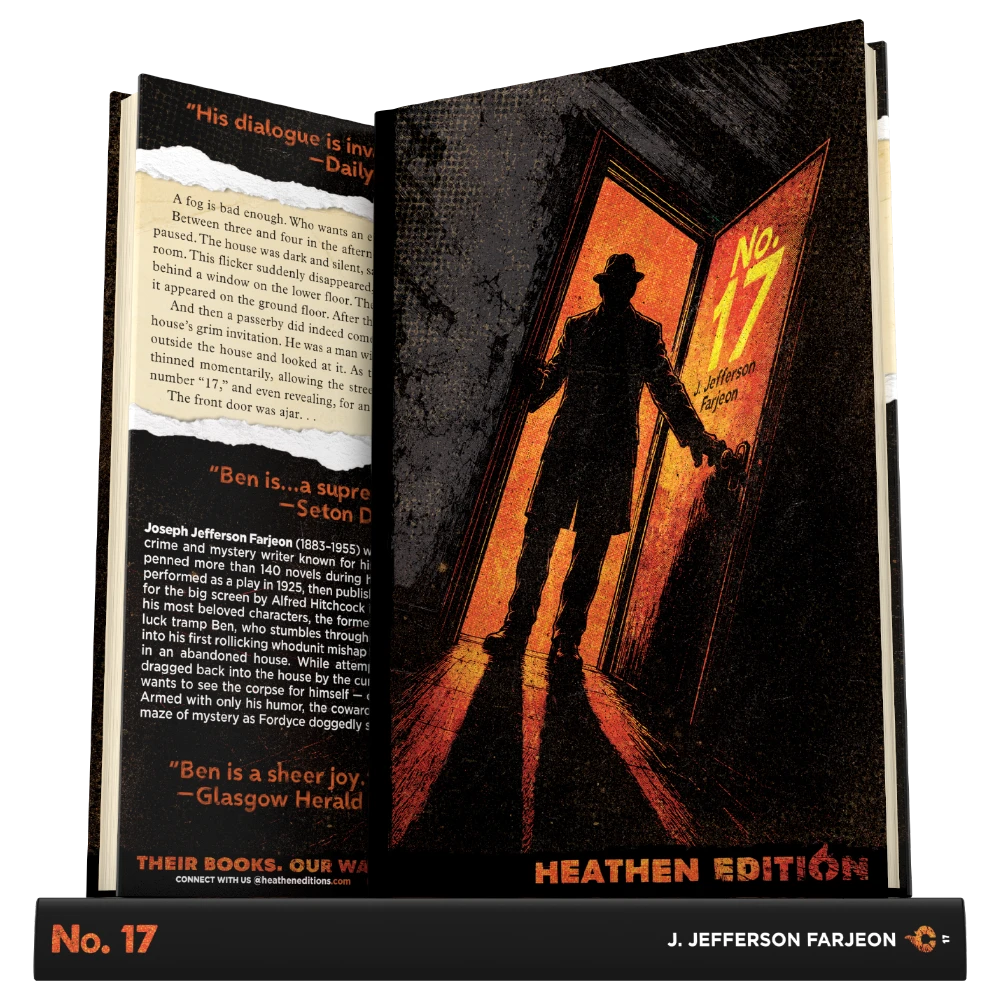
A fog is bad enough. Who wants an empty house thrown in?
Between three and four in the afternoon, however, a passerby might have paused. The house was dark and silent, saving for a very faint flicker in the top room. This flicker suddenly disappeared, to reappear a few seconds afterward behind a window on the lower floor. Then, again, it vanished, and then again it appeared on the ground floor. After that, it vanished completely.
And then a passerby did indeed come along, and appear to respond to the house’s grim invitation. He was a man with a crooked shoulder, and he paused outside the house and looked at it. As though to ensure his interest, the fog thinned momentarily, allowing the street lamp to shine more clearly on the number “17,” and even revealing, for an instant, the front door.
The front door was ajar . . .
Joseph Jefferson Farjeon (1883–1955) was an English playwright, screenwriter, and prolific crime and mystery writer known for his keen humor and flashing wit who penned more than 140 novels during his long career. In the No. 17 — first performed as a play in 1925, then published as a novel in 1926, and eternized for the big screen by Alfred Hitchcock in 1932 — Farjeon introduces one of his most beloved characters, the former merchant sailor now down-on-his-luck tramp Ben, who stumbles through fog-bound London and unwittingly into his first rollicking whodunit mishap when he happens upon a dead body in an abandoned house. While attempting to run away, he’s reluctantly dragged back into the house by the curious passerby Gilbert Fordyce, who wants to see the corpse for himself — only to find that it has disappeared! Armed with only his humor, the cowardly Ben is unwillingly plunged into a maze of mystery as Fordyce doggedly seeks answers.
Choose your…
Paperback
OTHER RETAILERS
Rate & Shelve It
Hardcover
Rate & Shelve It
Given the origins of this story, we have retained all of Farjeon’s British-isms, from his British words to his phonetic Cockney spellings. We have, however, updated a few hyphenated words to bring them in line with modern usage: lamp-post is now lamppost, passer-by has become passerby, etc.
The real bulk of our work lies in the 152 footnotes that we’ve appended throughout the text for clarity, context, and commentary where necessary, especially when deciphering several of Farjeon’s phonetic renderings of Ben’s Cockney words or phrases. Which is to say that we’ve done the head-scratching and reverse engineering so that you don’t have to!
Our Heathenry also includes 16 photos, illustrations, and newspaper clippings.
No. 17
“No. 17 holds the reader to the bitter end. It is one of the yarns which make you say: ‘I’ll read just one more chapter and then go to bed’—and you go to bed when there are no more chapters.” —Thomas S. Rice, The Brooklyn Daily Eagle
“Ben is a sheer joy.” —Glasgow Herald
“His dialogue is invariably amusing.” —Daily Mail
“Mr. Farjeon displays a great deal of knowledge about storytelling.” —The New York Times
“A very efficient narrator of thrillers.” —News Chronicle
“Few authors of detective stories are so persuasive as Mr. Farjeon. He has perfected the trick of leading you from a life of gentle commonplace into mazes of crime.” —Times Literary Supplement
“There may be contemporary story writers who are equals to Mr. Farjeon in the ability to put the reader swiftly and wholly under the spell of eerie and uncanny, but they have not come within our reading.” —New York World
“Jefferson Farjeon writes thrills enhanced by good writing, good humour, and good character sketches.” —Sunday Times
“Jefferson Farjeon is quite unsurpassed for creepy skill in mysterious adventures.” —Dorothy L. Sayers
“Mr. Farjeon discovered some time ago a good recipe for an entertaining story by mixing humour with thrills.” —Daily Telegraph
“Mr. Farjeon’s Ben is not merely a character but a parable. He is a mixture of Trimalchio and the Old Kent Road, a notable coward, a notable hero, above all a supreme humorist.” —Seton Dearden, Time and Tide
No. 17
Heathen Edition #17Published: October 17, 2026
Format: Paperback
- Retail: $14.95
- ISBN-10:
- ISBN-13: 9781948316170
- Dimensions: 8.5 x 5.5 x 0.53 inches
- Weight: 9 oz
- Retail: $24.95
- ISBN-10:
- ISBN-13: 9781963228175
- Dimensions: 8.75 x 5.75 x 0.68 inches
- Weight: 14 oz
Interior: Black & White on Creme Paper
Pages: 232 (+2 POD)
Language: English
Annotations: 152 Footnotes
Illustrations: 20
- Title Page
- Heathenry Flame
- 16 Additional Photos & Illustrations
- Honorary Heathen Headshot: J. Jefferson Farjeon
- Fiction / Mystery & Detective / Amateur Sleuth
- Fiction / Mystery & Detective / Traditional
- Fiction / Mystery & Detective / Private Investigators