A Voyage to Arcturus
Author
Translator
First Edition
Heathen Edition
Refreshed
Pages
Heathen Genera
Paperback ISBN
Hardcover ISBN
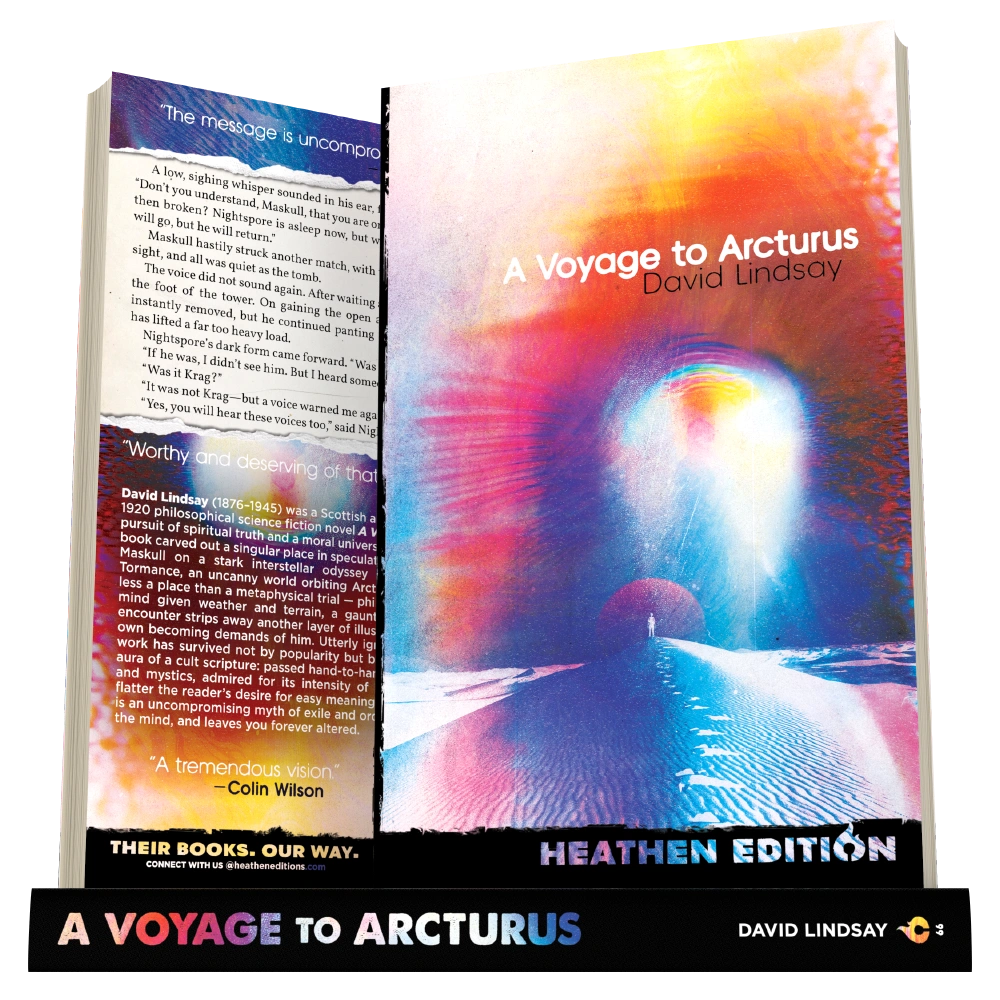
A low, sighing whisper sounded in his ear, from not more than a yard away. “Don’t you understand, Maskull, that you are only an instrument, to be used and then broken? Nightspore is asleep now, but when he wakes you must die. You will go, but he will return.”
Maskull hastily struck another match, with trembling fingers. No one was in sight, and all was quiet as the tomb.
The voice did not sound again. After waiting a few minutes, he redescended to the foot of the tower. On gaining the open air, his sensation of weight was instantly removed, but he continued panting and palpitating, like a man who has lifted a far too heavy load.
Nightspore’s dark form came forward. “Was Krag there?”
“If he was, I didn’t see him. But I heard someone speak.”
“Was it Krag?”
“It was not Krag—but a voice warned me against you.”
“Yes, you will hear these voices too,” said Nightspore enigmatically.
David Lindsay (1876–1945) was a Scottish author best remembered for the 1920 philosophical science fiction novel A Voyage to Arcturus. Fierce in its pursuit of spiritual truth and a moral universe as harsh as it is luminous, the book carved out a singular place in speculative literature. The story follows Maskull on a stark interstellar odyssey 37 light‑years from Earth to Tormance, an uncanny world orbiting Arcturus, where each landscape is less a place than a metaphysical trial — philosophies made flesh, states of mind given weather and terrain, a gauntlet for the soul where every encounter strips away another layer of illusion in search of what Maskull’s own becoming demands of him. Utterly ignored in Lindsay’s lifetime, the work has survived not by popularity but by revelation, long carrying the aura of a cult scripture: passed hand‑to‑hand, whispered about by writers and mystics, admired for its intensity of imagination and its refusal to flatter the reader’s desire for easy meaning. It is not a comforting book. It is an uncompromising myth of exile and ordeal that detonates logic, sears the mind, and leaves you forever altered.
A quick-ish update on A Voyage to Arcturus: We’ve moved its release date after it was brought to our attention that multiple versions of the text are floating around. And after doing a deep dive into the book’s publishing history, we’ve decided that our edition should be as reverent to the original as possible because we feel that David Lindsay’s message is too powerful to be adulterated beyond our usual Heathening.
In short, Ballantine Books revised the book in the 1960s in an attempt to make it more palatable for a 60s audience and introduced revisions that significantly and inexplicably altered portions of the text. Since that time, their version has blended in various forms with the original text and rendered many bastard versions, which, sadly, the base text that we initially used for our edition was one.
So, to correct course, we sought out the original 1920 UK Methuen release, which was the only edition proofed by Lindsay himself. Since copies of that edition aren’t cheap, we opted for the next best thing: the 1977 US Gregg Press edition, which was reproduced photographically from the original 1920 edition, and thus contains the exact same text. It wasn’t cheap itself, but worth it for this project!
So, we’ve been using that edition to do a line-by-line read-through and correction of our edition. It has been a lot of work, so far, but absolutely worth it, we believe, because — seriously — A Voyage to Arcturus is a book that operates on a whole other literary level. We’ve never read another book like it, and during our second read-through we felt like we accessed some of its mysteries that weren’t readily accessible or apparent during our first read, and we can only imagine what will be revealed upon our third read!
We place the book alongside The House on the Borderland: it’s like ingesting a psychedelic: you think you’re ready, but you’re not ready.
A Voyage to Arcturus
“The greatest novel of 20th century . . . a tremendous vision . . . Lindsay possessed towering genius.” —Colin Wilson, The Mind Parasites
“David Lindsay—a wonderful writer! A Voyage to Arcturus is a masterpiece! It’s an extraordinary work . . . quite magnificent.” —Clive Barker
“Lindsay was a realist . . . since he singularly refuses to give us even the most provisional final answer to the riddles he sets . . . There is no evasion on Lindsay’s part in leaving his novel on a suspended ending, for that suspended ending is us.” —George Hay, Horror: 100 Best Books
“As a story, its violence and color are enthralling: on a deeper level, it takes us to new worlds of moral experience. And it makes all the symbolic novels of the past ten years look soft.” —The Spectator
“Powerful, stark as the wild dream landscape of Arcturus it so beautifully describes, it makes a tremendous impression on the mind.” —Evening News
“A Voyage to Arcturus demands that David Lindsay be considered not as a mere fascinating one-off, as a brilliant maverick, but as one worthy and deserving of that shamanistic mantle; of the British visionary and apocalyptic legacy.” —Alan Moore
“The book is not allegory but vision. Lindsay’s imagery, often drawn from music, is burning and impressive. He uses words violently and cares nothing of grace . . . But what emerges after sympathetic reading is . . . a sense of the remarkable profundity and coherence of the vision. The message is uncompromising in its purity. The achievement of the book exactly balances the ambition of its intention. This, surely, is rare.” —The London Times
“Arcturus itself is not an ingratiating work; the shelf it occupies is a short one, reserved for titles more often to be found in lists than in reader’s pockets. The message it spells out is no comforting one.” —Fantasy: The 100 Best Books
A Voyage to Arcturus
Heathen Edition #66Published: October 2026
Format: Paperback
- Retail: $19.95
- ISBN-10:
- ISBN-13: 9781948316668
- Dimensions: 8.5 x 5.5 x 0.775 inches
- Weight: x.x oz
- Retail: $29.95
- ISBN-10:
- ISBN-13: 9781963228663
- Dimensions: 8.75 x 5.75 x 0.xx inches
- Weight: x.x oz
Interior: Black & White on Cream Paper
Pages: 310 (+2 POD)
Language: English
Annotations: 169 Footnotes
Illustrations: 4
- Title Page
- Heathenry Flame
- Honorary Heathen Headshot: David Lindsay
- End Title
- Fiction /
- Fiction /
- Fiction /