No products in the cart.

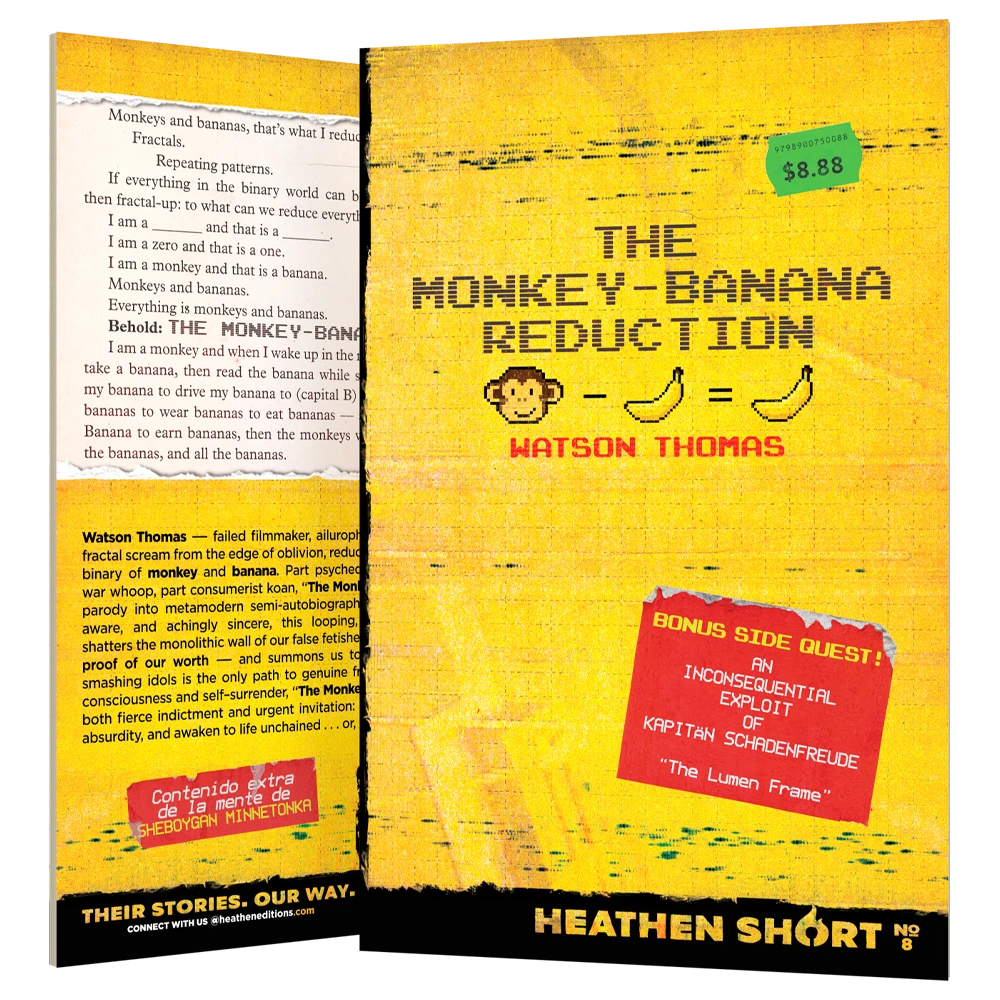
We’ll hop straight to it with a transcribed excerpt from a recent conference call we Heathens had with Watson Thomas and Sheboygan Minnetonka:
Heathen Shorts: (terrible British accent) Oi! What’s all this, then?
Watson Thomas: Well, here we go—
Sheboygan Minnetonka: Please speak with that accent for the rest of this call.
HS: (continued terrible British accent) Might be a bit too much, eh?
WT: Why are you—
SM: (laughs) This is great!
WT: —suddenly Australian?
HS: (terrible Australian accent) Cup-uh rooibos, eh?
SM: Roy–bows?
HS: Rooibos, eh?
WT: It’s a tea. Looks like roo-e-boss?
SM: Oh! Wait, that’s pronounced roy-bows?
HS: Rooibos, eh?
SM: Roy-bows. Roy-bows. Rooibos? It’s like—
WT: See what you’ve done?!
SM: —you can’t say it without sounding Australian.
Rooibos. Rooibos.
HS: Rooibos, eh?
SM: Rooibos, eh?
HS: (laughs)
WT: (sighs) Monkeys all.
SM: (better Australian accent) Cup-uh rooibos, eh?
HS: (chuckles) You know what my grandpa would say?
WT: Dad-burn your hide?!
SM: (laughs) What?
HS: There ain’t a boy here!
WT: Huh?
HS: He’d always say: one boy is all boy, two boys is half a boy, and three boys is no boy at all.
WT: Ah, I see—
SM: That’s so true! Three boys equals trouble!
HS: And here we are . . .
HS: All right, so, Watson, for real this time: What’s all this, then?
WT: “What does it all mean, all this shit I’m seein’?”
SM: (singing) There’s somethin’ happenin’ here—
HS: I guess walk us through what we’re about to, er—uh—what we’re already experiencing as a reader?
WT: Okay, so, let me see if I can condense this as briefly as possible: acid trip, ego death, mind blown, life implodes (but not because of the preceding), then the Creative stopped creating.
HS: Why not because of the preceding?
WT: My life was already imploding. The LSD-induced ego death was . . . you know those whistler fireworks?
SM: Yeah! (whistles), then—(explosion noise).
WT: It was like that. The Brilliant White Light was the (explosion noise) of the implosion.
HS: And that’s one of the Fragments?
WT: Yes. Its first line was how I described the ego death immediately after it happened, and, at the time, I knew exactly what that meant, but had absolutely no idea what I was saying (anyone familiar with the psychedelic experience will understand, maybe). It was—those were just the first words that came to me.
SM: Like a knee-jerk?
WT: Sort of? You know when someone hits you and the immediate, involuntary response is “Ow!” It was like—you know those rapid-fire montages in Snatch?
HS: Yes! Taxi, airplane, passport; boom-boom-boom—
WT: Imagine it like that: soaring through clouds, everything forgotten, even my name, me becomes I, Infinite Plane, Orb of Absolute Love, symbiosis, then I is me again and, “I have danced a cosmic dance, danced for eons.”
SM: Sounds wild. Sign me up!
HS: Okay, so (whistles), then (explosion noise), and then the Creative stopped creating? Why?
WT: I feel like I’m skipping over a lot, but, essentially, because disconnect. I felt disconnected and I needed to disconnect and so I disconnected. I went from writing daily to not writing at all. Before, I was the guy who could fire off a 10,000 word email before lunch. After, I felt like a monkey in 2001: A Space Odyssey.
HS: (laughs) How so?
WT: Well, you know how they’re just fiddling with the bones and they don’t understand them?
HS: Yes?
SM: Bones?! You mean bananas!
WT: Ha! Well, replace the bones — sorry, bananas — with words. I was a monkey who didn’t understand words. You know: picks up word, “HooHoo.” (makes hammering noises)
HS: How long did the creative drought last?
WT: Almost three years.
SM: That seems quite a stretch.
HS: You didn’t write anything during those three years?
WT: A little. Some poems. A few abandoned pieces. Nothing substantial until “A Conversation with Cassavetes.”
HS: Which is the last part of this Short?
WT: Yes. We end where I began again.
HS: And that’s not even substantial, right? It’s just 1200 words.
WT: Right. But that was the most at the time.
HS: So that “conversation” with Cassavetes ignited something?
WT: In a way, yeah. It reignited the writing pilot light.
SM: And you were tripping when you wrote that?
WT: Technically, yes, I was still in a three-tab experience, but I was on the comedown, the gentle glide.
HS: So it’s kind of a pseduo trip report?
WT: In some ways, yeah. Like the mention of voices, which is in no way schizo and in all ways my acid-brain having ∞ thoughts at once.
HS: Okay, so there’s a re-ignition à la Cassavetes. How long before “The Monkey-Banana Reduction”?
WT: Almost two years. I spent most of that time wrestling with trying to figure out the writing style/mode that became/produced “Monkey-Banana.” There were a lot of false starts and many more abandoned pieces. I knew I had things to say, but didn’t know how I wanted to say it, exactly, other than I knew I wanted it to replicate the psychedelic experience.
SM: Chaos.
WT: Yes. And that was the problem: How does one create, in literary form, the chaos of a psychedelic experience, but make it readable, make it entertaining, make it sincere, make it thought-provoking—make it personal and universal at the same time?
HS: Ah, there’s a quote from Robert Hunter—
SM: Who’s that?
HS: He was a lyricist for the Grateful Dead. I was listening to a retrospective on NPR after he passed in 2019, and in an interview he said, “If something is personal enough, there’s a certain line where it becomes universal.”
WT: Great quote, and very true.
SM: When you reduce everything to monkey/banana, then everything is universal.
WT: Exactly!
HS: So, what clicked? What broke the creative dam?
WT: When I started looping back to the 1984/Orwell riff and Head in “Monkey-Banana.” Before that, I kept struggling with how to create written fractals. The first time I circled back to those, I knew I had it. In that moment it was like being in the psychedelic experience—I could see infinity—and I knew it was working, where to go, what to write. At that time, all I could think to call what I had done was a fractal. It wasn’t until later that I discovered the Jane Alison book Meander, Spiral, Explode: Design and Pattern in Narrative, which has a whole chapter devoted to fractals, which both fascinated me and made me laugh when I read it because I realized I had blindly but intuitively brute-forced my way into that narrative pattern.
HS: That’s a great book. I read it after you mentioned it to me.
WT: Yeah, anyone interested in alternative/experimental narrative structures should definitely read it.
HS: Okay, so, man—I have so many more questions, but I don’t want to spoil anything . . . I guess let’s skip to how you end “Cassavetes” and how that ties into the Fragments that you’ve collected here.
WT: Yeah, so I end “Cassavetes” literally with a setup, which both speaks to individual writing sessions, kind of like an allusion to that writing maxim ‘end the session knowing where the next session will begin,’ but it’s also a Short setup for an Original payoff.
SM: I see what you did there!
WT: (laughs) And the Fragments in this Short are pieces of that larger work, tentatively entitled Infinity Awaits? Amuse It!
HS: Let’s talk visual style. I see some elements carried over from Propaganda?1Propaganda by Edward Bernays (Heathen Edition) now available, which was designed entirely by Watson Thomas.
WT: Yep, definitely. Working on that book gave me a lot of visual ideas that I’ve brought to this Short.
SM: That’s not a book, that’s a trip!
HS: (laughs) Yeah?
SM: It’s wild how you weave the Heathenry throughout the entire book.
HS: That was the idea, to make the book a visual representation of trying to tune into a frequency, where you’re reading Bernays’ instruction/analysis on propaganda, while receiving our Heathen propaganda between its chapters. Like two books blending in a cross-frequency.
SM: Yeah, that shit is wild!
HS: All right, so, Watson, I remember when I told you that we wanted to do this Short, you immediately said that we had to include Sheboygan’s short. Why?
WT: Because monkeys and bananas.
SM: (laughs) Right?!
WT: I think our works are great complimentary pieces. Not just because of the monkeys and bananas, or because we’re both “failed filmmakers” in our own ways, but because both pieces speak to the absurdity of this moment of ours, culturally. I’m riffing on consumerist materialism, Sheboygan’s riffing on the perpetual cognitive dissonance of social media. Both, ultimately, have net negative consequences for the individual.
HS: And I’ll take advantage of that segue way: Sheboygan, what was the inspiration for Schadenfreude?
SM: Some assholes.
HS: (laughs) Oh yeah?
SM: Yeah, some mentally-ill dude I haven’t spoken to in years decided to rake me over the coals on social media for a decade-old unfinished short film that he wasn’t a part of or even contributed to, and that trolling brought out more trolls, you know, people who never take creative risks themselves, but are quick to criticize other Creatives when they fail. If “Cassavetes” was a re-ignition of a writing pilot light for Watson, this trolling episode was someone leaving the gas on and KABOOM! for me.
HS: It definitely reads that way.
WT: Scathing, for sure.
HS: Those English subtitles, though.
WT: Right?!
SM: (laughs) Cranking that dissonance to eleven.
HS: Final thoughts?
SM: Rooibos, eh?
WT: Callback!
HS: Tea sounds good, actually.
WT: What’s your favorite?
HS: Depends on my mood, and what I have on hand. I like variety, so I’m constantly trying new blends, but I like bold, black teas. I think my current favorite is Lapsang Souchong.
SM: Whosa whatsa?
HS: (laughs) It’s a black tea smoke-dried over a pinewood or pine-needle fire.
SM: Say whaaaaat?
WT: What does that taste like?
HS: I call it the Scotch of teas.
WT: Oh!
SM: Sounds wild. Sign me up!
HS: It’s campfire in a cup, and so good.
WT: There should be a Heathen tea.
HS: We’ve thought about it.
SM: Stop thinking, start doing!
WT: What were you thinking?
HS: Something bold, complex, and smooth. I’d want to use Lapsang for its smokiness, but add dark chocolate and tobacco into the mix.
SM: Tobacco?
HS: Yeah, I hate the way it tastes, but I love the way chewing tobacco smells. Bit of nostalgia, I think — re: grandpa — but I’ve always wanted a tea that smells like fresh chewing tobacco.
WT: You son a bitch, I’m in.
SM: Heathen Tea: Where the words smoke and the leaves burn.
HS: Oh! Cut! Print!
Check out their review here: indiereader.com/book_review/the-monkey-banana-reduction-heathen-short