No products in the cart.

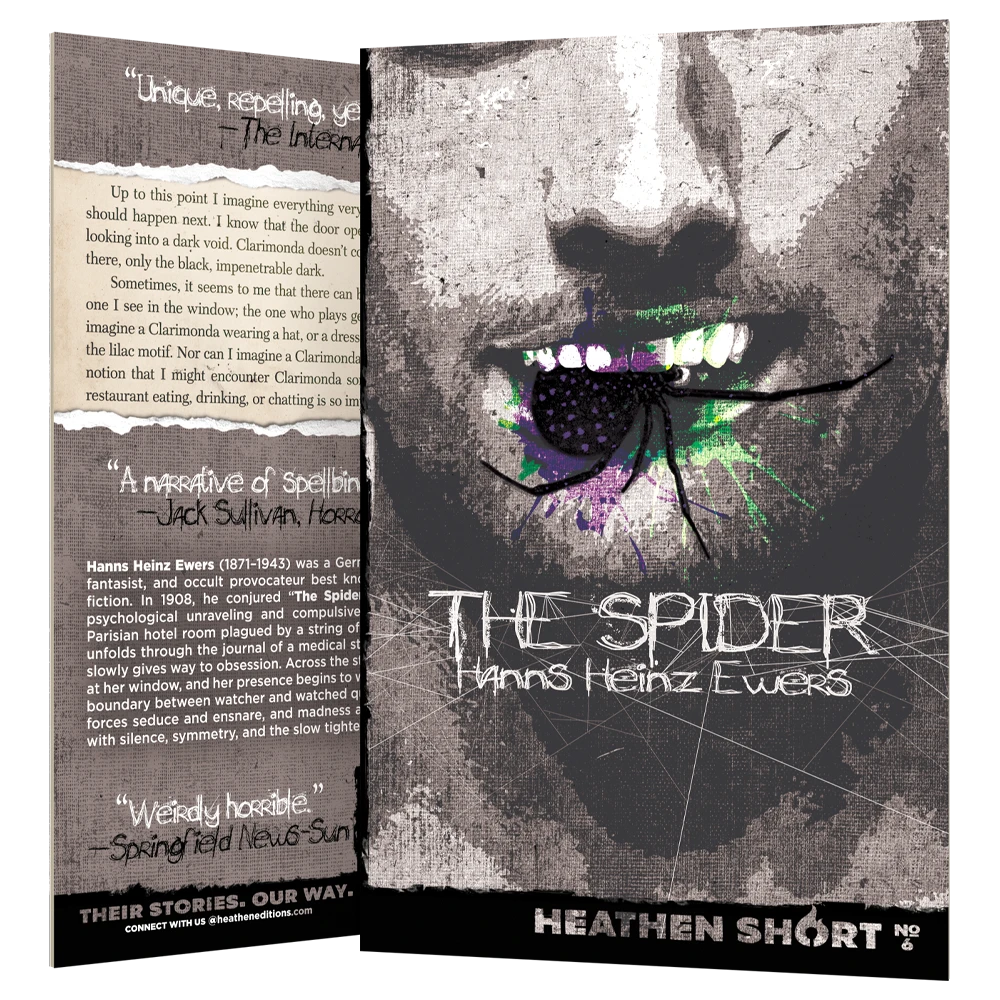
The Spider
Heathen Short #6
Author
Hanns Heinz Ewers
Translator
First Edition
1909
Heathen Short
January 6, 2026
Refreshed
Pages
36
Heathen Genera
Creepy AF
ISBN
979-8-90075-006-4
Up to this point I imagine everything very clearly, but I cannot see what should happen next. I know that the door opens. But then I stand before it, looking into a dark void. Clarimonda doesn’t come. Nothing comes. Nothing is there, only the black, impenetrable dark.
Sometimes, it seems to me that there can be no other Clarimonda but the one I see in the window; the one who plays gesture-games with me. I cannot imagine a Clarimonda wearing a hat, or a dress other than her black dress with the lilac motif. Nor can I imagine a Clarimonda without black gloves. The very notion that I might encounter Clarimonda somewhere in the streets or in a restaurant eating, drinking, or chatting is so improbable that it makes me laugh.
Hanns Heinz Ewers (1871–1943) was a German actor, poet, philosopher, fantasist, and occult provocateur best known for his decadent horror fiction. In 1908, he conjured “The Spider,” a chilling masterwork of psychological unraveling and compulsive entrapment. Set in a dim Parisian hotel room plagued by a string of ritualistic suicides, the story unfolds through the journal of a medical student whose rational inquiry slowly gives way to obsession. Across the street, a silent woman appears at her window, and her presence begins to weave into his thoughts as the boundary between watcher and watched quietly dissolves. Here, unseen forces seduce and ensnare, and madness arrives not with a scream but with silence, symmetry, and the slow tightening of a metaphysical web.
Test Your Might
In stock
OTHER RETAILERS
Rate & Shelve It
"Unique, repelling, yet irresistible."
The International
Heathenry
Contents
Praise
Details
Heathenry
What a wicked little story, this!
First published in German as “Die Spinne” in Ewers’ 1909 short story collection Die Besessenen (The Possessed), which notes on the story’s epigraph page that he first conjured the tale in Paris, August 1908.
Six years later, the story received its first uncredited English translation as “The Spider” in the December 1915 edition of literary and arts journal The International with the following introduction:
“The International has for many years published stories of an exceptionally high and unusual quality. Many of the finest modern short stories have for the first time appeared in the columns of this magazine. The following powerful, symbolic tale is from the pen of Hanns Heinz Ewers—the Edgar Allan Poe of Germany and one of the most notable authors writing in the German language. His fantastic imagination is perhaps best seen in the following story—unique, repelling, yet irresistible.”
And while we’re not entirely sure, because tracing this story’s early publication history is frustratingly iffy at best, its next English translation appears 16 years later by Walter F. Kohn as collected and published in the 1931 “chills and thrills” anthology Creeps by Night, curated and edited—surprisingly!—by that maestro of hardboiled detective fiction, Dashiell Hammett.
Then, 31 years later, a second uncredited (we think) translation appeared in the 1962 Ace Books anthology More Macabre edited by Donald A. Wollheim.
From there, the story began slipping into horror anthologies with increasing regularity from the 1970s onward, sometimes recycling Kohn’s translation, sometimes maintaining the now time‑honored custom of anonymous, uncredited meddling. Our edition happily aligns with that latter tradition, selected because we believe this particular rendering carries a modern snap and, dare we say, a little extra bite.
But wait—let’s rewind: the seed of Ewers’ story can be traced back to the 1857 short “The Invisible Eye” by the French duo and masters of the macabre Erckmann-Chatrian, wherein three guests have committed suicide in a specific room of an old inn and an artist arrives to solve the mystery. And, whether intentional or not, Ewers spun his inspiration with a delightful little loop-the-loop: “The Invisible Eye” is set in a hotel in Nuremberg, Germany, and was first written in French, whereas “The Spider” is set in a hotel in Paris, France, and was first written in German. C’est wunderbar!
As for the text, given this translation’s modernity little editing Heathening was required on our part. The bulk of our work lies in the twenty-odd footnotes we’ve appended for context, clarity, and commentary where necessary.
Finally, we must . . . we must . . . must . . . and then . . .
Contents
Heathenry: Thoughts on the Text
“The Spider“
“The Spider“
Praise
“The following symbolic tale is from the pen of Hanns Heinz Ewers—the Edgar Allan Poe of Germany and one of the most notable authors writing in the German language. His fantastic imagination is perhaps best seen in the following story—unique, repelling, yet irresistible.” —The International
“If you like the weirdly horrible, read ‘The Spider’ by Hanns Heinz Ewers.” —The Springfield News-Sun
“ . . . themes that would have warmed the heart of a Poe or Bierce. Take, for instance, Hannz Heinz Ewers’ ‘The Spider.’ In this short-story the reader is treated to 15 minutes of chilled suspense that he will remember a long, long time.” —The Buffalo Times
“A tale as terrible as Edgar Allan Poe’s most ghastly story.” —The Fatherland
“In the present generation German horror-fiction is most notably represented by Hanns Heinz Ewers, who brings to bear on his dark conceptions an effective knowledge of modern psychology . . . short stories like ‘The Spider’ contain distinctive qualities which raise them to a classic level.” —H.P. Lovecraft
“Ewers’ horror is more utter than Poe’s, both in atmosphere and in incident.” —Walter F. Kohn, The New Republic
“Of Ewers’s short horror stories, the most famous is ‘The Spider,’ a splendid tale that presents . . . a narrative of spellbinding intensity. Ewers was fond of femme fatale creations, and in ‘The Spider’ he gives us one of the most nightmarish and original evil females in literature.” —Jack Sullivan, Horror Literature
Details
The Spider
Heathen Short #6Published: January 6, 2026
Format: Paperback
Retail: $6.95
ISBN-13: 9798900750064
Dimensions: 8.5 x 5.5 x 0.1 inches
Weight: 2.3 oz
Cover: Matte Finish
Interior: Black & White on Cream Paper
Pages: 36 (+2 POD)
Language: English
Annotations: 25 Footnotes
Illustrations: 4
- Title Page
- Heathenry Flame
- Honorary Heathen Headshot: Hanns Heinz Ewers
- End Title
- Fiction / Horror / Monsters & Creatures
- Fiction / Occult & Supernatural
- Fiction / Short Stories (single author)



The Heathen Newsletter
Want to be kept in the loop about new Heathen books, receive discounts and random cat photos, and unwillingly partake in other tomfoolery? Subscribe to our newsletter! We promise we won’t harass you – much. Also, we require your first name so that we can personalize your emails. ❤️
@heatheneditions #heathenedition
Copyright © 2026 Heathen Creative, LLC. All rights reserved.