The Three Impostors
Author
Translator
First Edition
Heathen Edition
Refreshed
Pages
Heathen Genera
Paperback ISBN
Hardcover ISBN
"It is all more strange than I fancied," he said at last. "It was queer enough what I saw; a man is sauntering along a quiet, sober, every-day London street, a street of gray houses and blank walls, and there, for a moment, a veil seems drawn aside, and the very fume of the pit steams up through the flagstones, the ground glows, red hot, beneath his feet, and he seems to hear the hiss of the infernal caldron. A man flying in mad terror for his life, and furious hate pressing hot on his steps with knife drawn ready; here indeed is horror. I tell you, Phillipps, I see the plot thicken, our steps will henceforth be dogged with mystery, and the most ordinary incidents will teem with significance . . .
Arthur Machen (1863–1947), born Arthur Llewellyn Jones, was a Welsh mystic whose fictions braid wonder with spiritual peril along the shadowed edge of the Victorian era. The Three Impostors is his most elaborate masquerade: a sequence of seemingly disconnected encounters across London — chance meetings, curious tales, whispered confessions — all threaded by the hunt for a missing young man in spectacles whose name no one speaks plainly. What begins as a polite inquiry becomes a hall of mirrors. A trio of strangers, each more affable than the last, recount stories that feel like diversions: a secret society glimpsed at dusk, a ritual in a mountain pass, a scholar undone by forbidden lore, and the tantalizing appearance of a Gold Tiberius coin that seems to pass from tale to tale like a tainted relic. Machen turns the labyrinthine tale‑cycle into a trapdoor; each story is bait, each narrator a mask, each coincidence a tightening noose. When the imposture collapses, and the pursuit resolves not in detection but in exposure — of motive, of cruelty, of the terrible cost of curiosity — who has been deceived: the characters, or you? And why have you been permitted to witness it?
Now, as for the rest of our Impostors, we have kept intact all of Machen’s British spellings, but we have updated several of his hyphenated words to bring them in line with modern usage: to-night is now tonight, good-by has become goodbye, and so on.
The great majority of our work, however, has been in the 350+ footnotes that we’ve appended throughout the text to enhance your reading and provide clarity, context, and commentary where necessary.
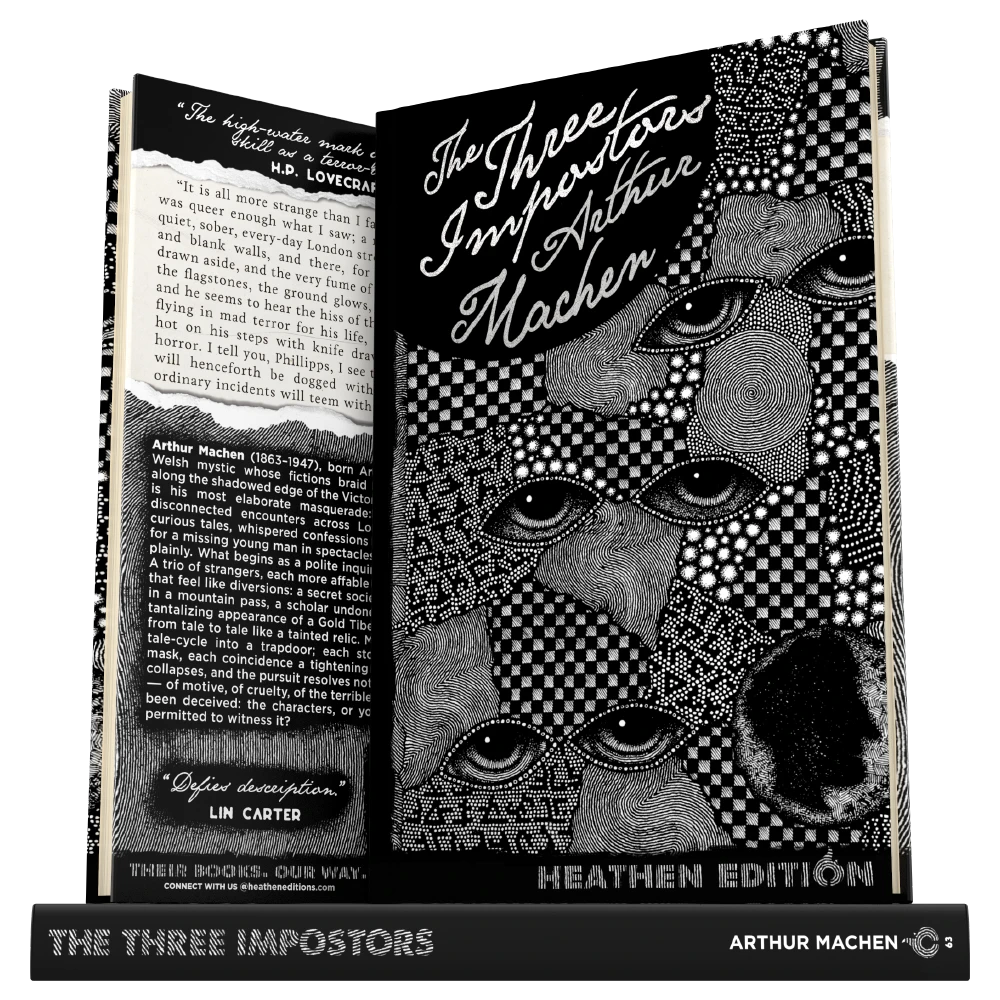
And we’d be remiss if we didn’t mention the gorgeous cover art we commissioned for this edition, which feels as if it were conjured straight from the Aesthetic Movement by Rhode Islander Jacob Blanchet. You can read more about Jacob in our Meet the Artist profile. And you can and you should follow him on Instagram: @pictishdreams
Lastly, and to better prepare you for the pages ahead, we simply want to say that this book is masterful, full stop. Machen initially casts his net wide, but then slowly, cumulatively brings it all together in the final sentence of the final paragraph of the final page of the final chapter.
It’s so good.
Introduction by Machen
The Three Impostors
“The Three Impostors, a story cycle within a cleverly concealed frame. Two of the stories — ‘Novel of the Black Seal’ and ‘Novel of the White Powder’ — have long been recognized as classics of the supernatural.” —E.F. Bleiler, Supernatural Fiction Writers
“Edgar Allan Poe, in his darkest mood, never pictured such awful possibilities as are to be found herein.” —The Whitehall Review
“Recent fiction includes nothing with more individuality and distinction than Mr. Machen’s story, The Three Impostors. It is weird, gruesome, fascinating.” —The Yorkshire Post
“The Three Impostors is a book of remarkable promise, exceedingly clever, quite absorbing in its interest, and grim with the most uncanny of developments.” —The Sun
“A book in every way calculated to excite remark, and one which will not soon be forgotten.” —The Library
“In the episodic novel of The Three Impostors occur certain tales which perhaps represent the high-water mark of Machen’s skill as a terror-weaver.” —H.P. Lovecraft
“One of the most bizarre, subtle, and uncanny books written since Poe is Arthur Machen’s The Three Impostors.” —The Newcastle Chronicle
“Of all the books that come to my mind, The Three Impostors most completely defies description. Like Don Quixote or Lolita, it has almost everything in it: adventure, comedy, romance, horror, satire, dream, nightmare, and idyll. The book is an almost inexhaustible source of excitement and pleasure; perhaps that is why I find myself returning to it again and again, finding therein each time some new delight I had never before noticed.” —Lin Carter
The Three Impostors
Heathen Edition #63Published: October 10, 2026
Format: Paperback
- Retail: $14.95
- ISBN-10: 1948316633
- ISBN-13: 9781948316637
- Dimensions: 8.5 x 5.5 x 0.50 inches
- Weight: 9 oz
- Retail: $24.95
- ISBN-10: 1963228634
- ISBN-13: 9781963228632
- Dimensions: 8.75 x 5.75 x 0.63 inches
- Weight: 14 oz
Interior: Black & White on Creme Paper
Pages: 218 (+2 POD)
Language: English
Annotations: 351 Footnotes
Illustrations: 4
- Title Page
- Heathenry Flame
- Machen Key
- Honorary Heathen Headshot: Arthur Machen
- Fiction / Occult & Supernatural
- Fiction / Fairy Tales, Folk Tales, Legends & Mythology
- Fiction / Horror / Psychological