No products in the cart.

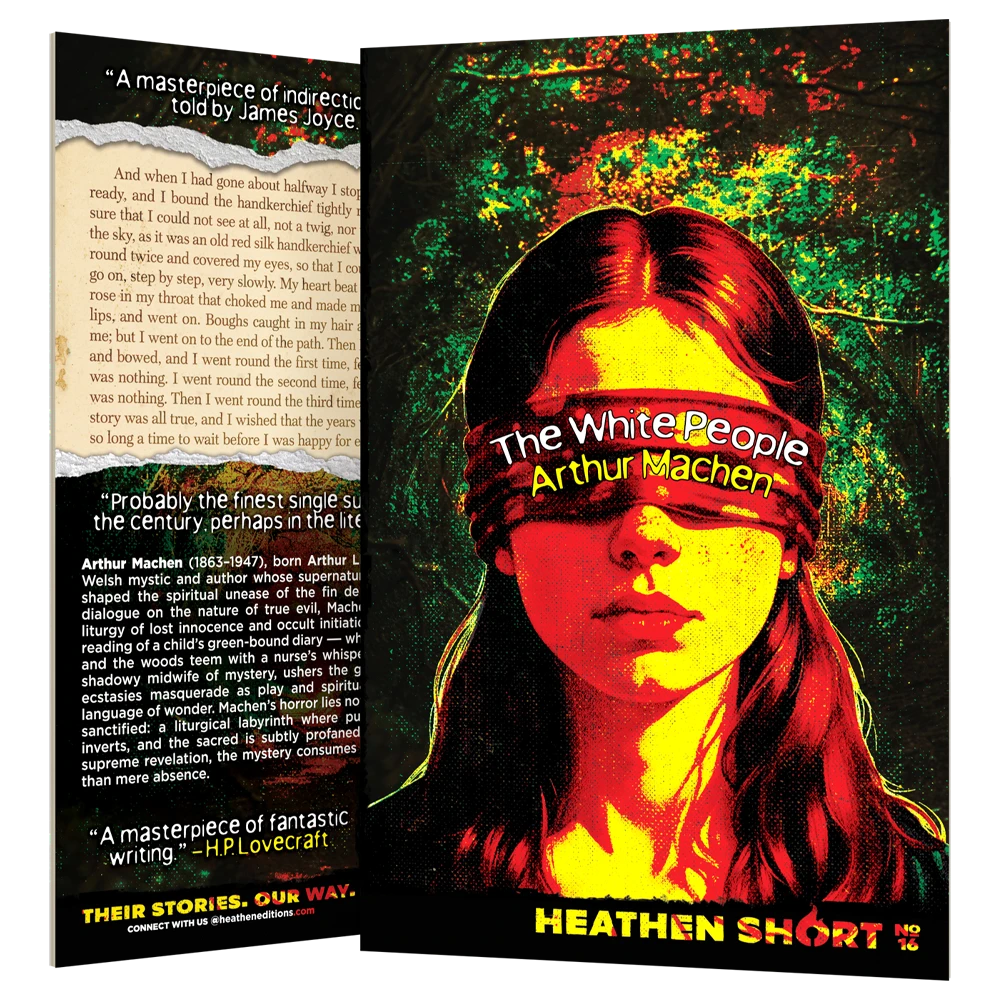
The White People
Heathen Short #16
Author
Arthur Machen
Translator
First Edition
January 1904
Heathen Short
January 25, 2026
Refreshed
Pages
58
Heathen Genera
Creepy AF
ISBN
979-8-90075-016-3
And when I had gone about halfway I stopped, and turned round, and got ready, and I bound the handkerchief tightly round my eyes, and made quite sure that I could not see at all, not a twig, nor the end of a leaf, nor the light of the sky, as it was an old red silk handkerchief with large yellow spots, that went round twice and covered my eyes, so that I could see nothing. Then I began to go on, step by step, very slowly. My heart beat faster and faster, and something rose in my throat that choked me and made me want to cry out, but I shut my lips, and went on. Boughs caught in my hair as I went, and great thorns tore me; but I went on to the end of the path. Then I stopped, and held out my arms and bowed, and I went round the first time, feeling with my hands, and there was nothing. I went round the second time, feeling with my hands, and there was nothing. Then I went round the third time, feeling with my hands, and the story was all true, and I wished that the years were gone by, and that I had not so long a time to wait before I was happy for ever and ever.
Arthur Machen (1863–1947), born Arthur Llewellyn Jones, was a prolific Welsh mystic and author whose supernatural, fantasy, and horror fiction shaped the spiritual unease of the fin de siècle. Framed by a fireside dialogue on the nature of true evil, Machen’s “The White People” is a liturgy of lost innocence and occult initiation, spiraling inward through a reading of a child’s green-bound diary—where nursery tales become rites and the woods teem with a nurse’s whispered catechisms. The nurse, a shadowy midwife of mystery, ushers the girl into a world where pagan ecstasies masquerade as play and spiritual trespass is cloaked in the language of wonder. Machen’s horror lies not in what is seen, but in what is sanctified: a liturgical labyrinth where purity becomes peril, theology inverts, and the sacred is subtly profaned. As the girl writes toward a supreme revelation, the mystery consumes—and what remains is more than mere absence.
Test Your Might
In stock
OTHER RETAILERS
Rate & Shelve It
“A masterpiece of fantastic writing, with almost unlimited power in the intimation of potent hideousness and cosmic aberration.”
H.P. Lovecraft
Heathenry
Contents
Praise
Details
Heathenry
“The White People” is Arthur Machen’s most quietly perilous work, a story that pretends to be a philosophical dialogue but smuggles in something far older and stranger.
Its first appearance was in the inaugural January 1904 issue of Horlick’s Magazine and Home Journal for Australia, India and the Colonies, published in London by James Elliott & Co. and edited by British poet and scholarly mystic A. E. Waite.1Arthur Edward Waite (1857–1942) was a British author who wrote extensively on the occult and Western esotericism. It was a curious magazine whose purpose was partly literary, partly promotional: it existed to push Horlick’s Malted Milk while smuggling in fiction, occult essays, and colonial miscellany. Waite used his editorial position to bring in writers he admired — including Machen — and to slip in his own occult pieces. The result is a magazine that feels half like an Edwardian lifestyle periodical and half like a secret-society newsletter. Two years later, Machen collected the story with five others in his 1906 work The House of Souls.
The frame of “The White People” is simple: two men chatting by lamplight about the nature of sin, but the real work is “The Green Book” one loans the other — the private journal of a young girl who has wandered into rites and suspicions that civilized language can barely name: older than Christianity, older than Rome, older than the names we bestow on fear. It is not quite a ghost story and not quite a fairy tale; it’s built like a nesting doll — a conversation containing a manuscript containing a revelation. And that revelation is not safe.
What gives the story its lasting force is Machen’s refusal to reduce evil to a minor infraction when, in truth, it is a metaphysical wound. In his hands, sin becomes a mystery, a force, an inversion of holy polarity — something that can be so deep it becomes invisible, like an organ note reverberating below the threshold of hearing. The girl’s voice is lyrical, innocent, almost pastoral, yet every page she writes is a step deeper into a realm where the old gods still breathe. Machen never shows the horror directly; he lets it shimmer at the edges, where it feels most alive, where it becomes a study at thresholds: childhood and adulthood, play and ritual, curiosity and damnation. It is a work that whispers instead of shouts, and its whisper is far more unsettling than any scream.
“The White People” is a reminder of what literature can do when it refuses to explain itself. It is a text that behaves like a relic: half‑decoded, half‑forbidden, humming with the sense that something older than doctrine is still alive in the hills and hollows. Machen, more than any of his contemporaries, believed that the deepest terrors and the deepest ecstasies spring from the same root. In this story, he points to where that root is just about to breach the surface — or are you already standing on it?
As for the text, this may be the least invasive editing Heathening we’ve ever performed on a story as we have no real alterations to speak of; our efforts have been focused instead on the 60+ footnotes we’ve appended throughout for context, clarity, and commentary where necessary.
Finally, we’ll part with Vincent Starrett’s observation of Machen’s work: “His sentences move to sonorous, half-submerged rhythms, swooning with pagan color and redolent of sacerdotal incense.” Inhale . . . exhale . . . now divine . . .
Contents
Heathenry: Thoughts on the Text
“The White People“
“The White People“
Praise
“A masterpiece of indirection, a Lovecraft plot told by James Joyce.” —S.T. Joshi, The Weird Tale
“This document is probably the finest single supernatural story of the century, perhaps in the literature.” —E.F. Bleiler, The Guide to Supernatural Fiction
“If I were to list the greatest supernatural short stories of all time, I would start with Arthur Machen’s ‘The White People,’ about a young girl’s unknowing initiation into an ancient, otherworldly cult.” —Michael Dirda, The Washington Post
“Machen’s gift has aways been exceptional, both as to the imagination behind all his writing and his capable handling of English prose.” —Evening Standard
“Lovers of the occult and the horrible will find much to their liking.” —Boston Evening Transcript
“Machen’s narrative, a triumph of skilful selectiveness and restraint, accumulates enormous power as it flows on in a stream of innocent childish prattle . . . a masterpiece of fantastic writing, with almost unlimited power in the intimation of potent hideousness and cosmic aberration.” —H.P. Lovecraft
“There is a great deal that is clever in Mr. Arthur Machen’s book and not a little that is creepy. He has the true art of the storyteller.” —The Newcastle Daily Chronicle
“It is an amazing brew that Mr. Machen has mixed. Take all the pseudo-science of the ancients, all the excesses of the frantic heathen, all the monkish superstitions, all the notions of the spiritualists, the theosophists, and the cults that lie back of their cult, and stir them together with a long, long spoon, savoring the modern reverence for the scientific and enriching with a manner that Joseph Conrad or Louis Stevenson might admire.” —Elia W. Peattie, The Chicago Daily Tribune
Details
The White People
Heathen Short #16Published: January 25, 2026
Format: Paperback
Retail: $7.95
ISBN-13: 9798900750163
Dimensions: 8.5 x 5.5 x 0.15 inches
Weight: 3.1 oz
Cover: Matte Finish
Interior: Black & White on Cream Paper
Pages: 58 (+2 POD)
Language: English
Annotations: 64 Footnotes
Illustrations: 3
- Title Page
- Heathenry Flame
- Honorary Heathen Headshot: Arthur Machen
- Fiction / Occult & Supernatural
- Fiction / Fairy Tales, Folk Tales, Legends & Mythology
- Fiction / Horror / Psychological
The Heathen Newsletter
Want to be kept in the loop about new Heathen books, receive discounts and random cat photos, and unwillingly partake in other tomfoolery? Subscribe to our newsletter! We promise we won’t harass you – much. Also, we require your first name so that we can personalize your emails. ❤️
@heatheneditions #heathenedition
Copyright © 2026 Heathen Creative, LLC. All rights reserved.