No products in the cart.

The Yellow Wallpaper
Heathen Short #1
Author
Charlotte Perkins Gilman
Translator
First Edition
January 1892
Heathen Short
December 17, 2025
Refreshed
Pages
38
Heathen Genera
Creepy AF
ISBN
979-8-90075-001-9
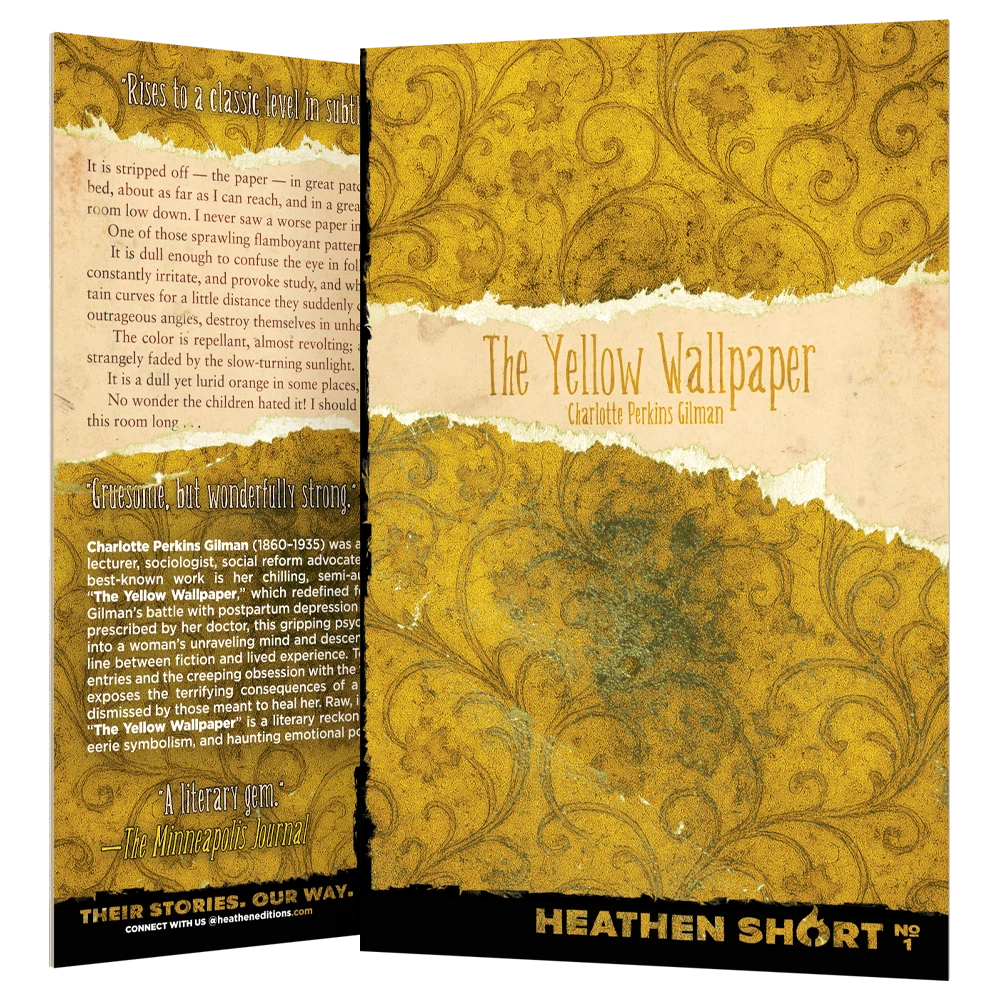
It is stripped off — the paper — in great patches all around the head of my bed, about as far as I can reach, and in a great place on the other side of the room low down. I never saw a worse paper in my life.
One of those sprawling flamboyant patterns committing every artistic sin.
It is dull enough to confuse the eye in following, pronounced enough to constantly irritate, and provoke study, and when you follow the lame, uncertain curves for a little distance they suddenly commit suicide — plunge off at outrageous angles, destroy themselves in unheard-of contradictions.
The color is repellant, almost revolting; a smouldering, unclean yellow, strangely faded by the slow-turning sunlight.
It is a dull yet lurid orange in some places, a sickly sulphur tint in others.
No wonder the children hated it! I should hate it myself if I had to live in this room long . . .
Charlotte Perkins Gilman (1860–1935) was an American humanist, author, lecturer, sociologist, social reform advocate, and utopian feminist whose best-known work is her chilling, semi-autobiographical masterpiece, “The Yellow Wallpaper,” which redefined feminist literature. Inspired by Gilman’s battle with postpartum depression and the damaging “rest cure” prescribed by her doctor, this gripping psychological short story plunges into a woman’s unraveling mind and descent into madness that blurs the line between fiction and lived experience. Told through fragmented diary entries and the creeping obsession with the wallpaper in her room, Gilman exposes the terrifying consequences of a woman being confined and dismissed by those meant to heal her. Raw, intimate, and disturbingly real, “The Yellow Wallpaper” is a literary reckoning whose timeless brilliance, eerie symbolism, and haunting emotional power is an unnerving triumph.
Test Your Might
In stock
OTHER RETAILERS
Rate & Shelve It
"Grows and increases with a perfect crescendo of horror..."
Anne Montgomerie
Conservator
Heathenry
Contents
Praise
Details
Heathenry
To hyphen or not to hyphen, that is the question . . .
First published in the January 1892 edition of The New England Magazine as “The Yellow Wall-paper” (with hyphen) and bearing her first married name — Charlotte Perkins Stetson — this story arrives with a title whose hyphen has a history all its own.
We call attention to it only because, while we’ve chosen the modern form in keeping with our standard Heathening procedure — wallpaper (without hyphen) — we also acknowledge the symbolic duality unlocked when the hyphen is present: wall‑paper.
That hyphen isn’t decoration; it’s a wound. It splits wall from paper, revealing both the barrier that cages our narrator and the material that taunts her.
Follow the duality further and the wall becomes two things at once: literal, in that it confines her, and figurative, in that she is pressed against a wall of disconnection and misunderstanding erected by those who profess to heal her. And yes, the hideous paper clinging to that wall is a literal material — but it is also figurative in that material can be facts, information, and ideas. You know, the same “facts, information, and ideas” that convinced those around her that a “rest cure” was medicine rather than a sentence.
It’s no wonder this story has endured for as long as it has, the layers of wisdom to be mined are immense. Enough so that one would think its hyphen usage has been consistent since its first publication, yet alas . . .
Now, as for the text, in addition to the wallpaper hyphen, we have eliminated some others so as to render them modern (to-day is today, to-morrow is tomorrow, and so on).
As a bonus to “Why I Wrote The Yellow Wallpaper?” we’ve included a facsimile of the “protest” Gilman mentions so you can judge it yourself.
Opposite that, you’ll find Gilman’s 1893 poem “She Walketh Veiled and Sleeping” as we believe it pairs well with this material.
We’ve also appended 29 footnotes to enhance your reading of the text, and to provide clarity, context, and commentary where necessary.
In all, we’re quite pleased with how well our first Heathen Short has come together, and believe there’s only one word that can accurately describe it: bitchin’ — ♥!
Contents
“Perilous Stuff”
“She Walketh Veiled and Sleeping”
Heathenry: Thoughts on the Text
“The Yellow Wallpaper“
Why I Wrote The Yellow Wallpaper?
“She Walketh Veiled and Sleeping”
Heathenry: Thoughts on the Text
“The Yellow Wallpaper“
Why I Wrote The Yellow Wallpaper?
Praise
“A weird story.” —The Literary World
“’The Yellow Wallpaper‘ is a literary gem and ranks with Poe’s best work.” —The Minneapolis Journal
“Charlotte Perkins Gilman’s greatest literary achievement . . . a landmark feminist work and an important contribution to the American literary canon.” —Twentieth-Century Literary Criticism
“Rises to a classic level in subtly.” —H.P. Lovecraft
“That strange study of physical environment, ‘The Yellow Wallpaper,’ deservedly ranks as one of the most powerful of American short stories.” —Current Literature
“Deceptively simple.” —Loralee MacPike, American Literary Realism 1870-1910
“Grows and increases with a perfect crescendo of horror . . . The story is simple, serious, sly, fascinating, torturing. It is embodied excitement. It is brooding insanity.” —Anne Montgomerie, Conservator
“A striking example of unadulterated pessimism in book form is ‘The Yellow Wallpaper,’ which is quite hair-raising and as creepy as even the most perverted imagination could desire to feed upon.” —The Richmond Times-Dispatch
“[A] remarkable study in progressive mania . . . It is a gruesome, but wonderfully strong and vivid little story . . . But unless the publishers of the book wish to be responsible for a large crop of maniacs, they ought not to have covered it with what is apparently a reproduction of that fateful wallpaper. After one glance at its pattern, one cannot wonder that the poor woman went crazy.” —The Los Angeles Times
Details
The Yellow Wallpaper
Heathen Short #1Published: December 17, 2025
Format: Paperback
Retail: $6.95
ISBN-13: 9798900750019
Dimensions: 8.5 x 5.5 x 0.10 inches
Weight: 2.3 oz
Cover: Matte Finish
Interior: Black & White on Cream Paper
Pages: 38 (+2 POD)
Language: English
Annotations: 29 Footnotes
Illustrations: 4
- Title Page
- “Perilous Stuff”
- Heathenry Flame
- Honorary Heathen Headshot: Charlotte Perkins Gilman
- Fiction / Feminist
- Fiction / Horror / Psychological
- Fiction / Psychological


The Heathen Newsletter
Want to be kept in the loop about new Heathen books, receive discounts and random cat photos, and unwillingly partake in other tomfoolery? Subscribe to our newsletter! We promise we won’t harass you – much. Also, we require your first name so that we can personalize your emails. ❤️
@heatheneditions #heathenedition
Copyright © 2026 Heathen Creative, LLC. All rights reserved.