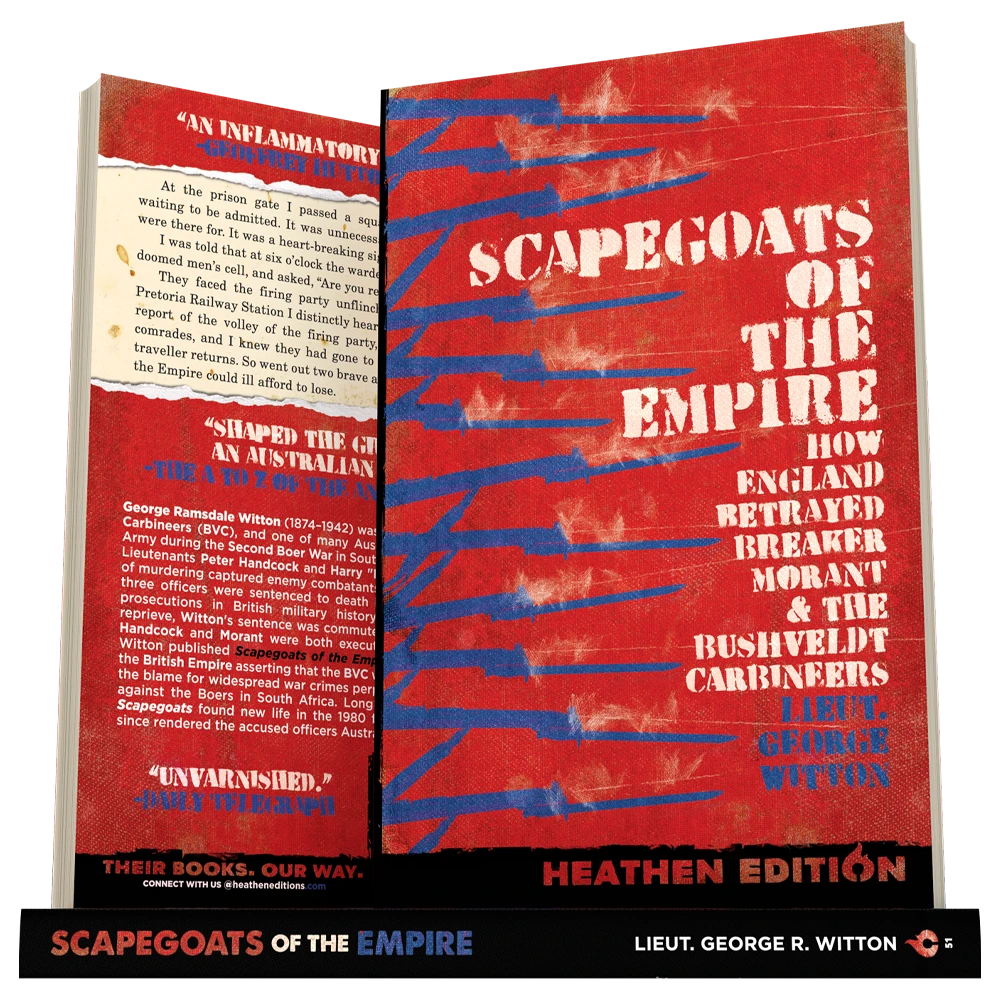
Scapegoats of the Empire
Author
Translator
First Edition
Heathen Edition
Refreshed
Pages
Heathen Genera
Paperback ISBN
Hardcover ISBN
At the prison gate I passed a squad of Cameron Highlanders waiting to be admitted. It was unnecessary to ask why or what they were there for. It was a heart-breaking sight.
I was told that at six o’clock the warders threw open the door of the doomed men’s cell, and asked, “Are you ready?”
They faced the firing party unflinchingly. While waiting at the Pretoria Railway Station I distinctly heard in the clear morning air the report of the volley of the firing party, the death knell of my late comrades, and I knew they had gone to that bourne from whence no traveller returns. So went out two brave and fearless soldiers, men that the Empire could ill afford to lose.
George Ramsdale Witton (1874–1942) was a lieutenant in the Bushveldt Carbineers (BVC) and one of many Australians serving in the British Army during the Second Boer War in South Africa. Court-martialed with Lieutenants Peter Handcock and Harry “Breaker” Morant and accused of murdering captured enemy combatants and an unarmed civilian, the three were sentenced to death in one of the first war crime prosecutions in British military history. Granted an eleventh-hour reprieve, Witton’s sentence was commuted to life imprisonment, while Handcock and Morant were both executed by firing squad. In 1907, Witton published Scapegoats of the Empire, a scathing indictment of the British Empire asserting that the BVC were made scapegoats to take the blame for widespread war crimes perpetrated by British authorities against the Boers in South Africa. Long suppressed and unavailable, the book found new life in the 1980 film Breaker Morant, and has since rendered the accused officers Australian martyrs and icons.
Choose your…
Paperback
OTHER RETAILERS
Rate & Shelve It
Hardcover
Rate & Shelve It
Coming soon . . .
Scapegoats of the Empire
“The most sensational narrative of the [Boer] war is George R. Witton’s Scapegoats of the Empire.” —The Oxford Companion to Australian Literature
“Witton’s testimony was published as Scapegoats of the Empire. The book shaped the growth of an Australian legend in which Morant and Handcock were made martyrs and victims.” —The A to Z of the Anglo-Boer War
“There is little question Harry, P. J. and George were victims of politics and national greed who were sacrificed on the altar of international politics — the inevitable result of empire building.” —Mark Duran Samuels, The Southern Illinoisan
“No one is more a villain than the British commander in South Africa, the famous hero Lord Kitchener of Khartoum.” —Robert Sklar, Cineaste
“Lieut. Witton cultivates no grace of style; he delivers his round unvarnished tale simply, often forcibly. His book is a personal vindication.” —The Darling Downs Gazette
“When it was first published Scapegoats of the Empire was an inflammatory document. Witton’s story is a personal justification but it has the ring of truth. Written almost as sparingly as a military report, it occasionally bursts into strong feeling . . . this book is a worthwhile venture in historical documentation.” —Geoffrey Hutton, The Age
“Not one man in ten million has had the flashes of melodrama in his life that were the lot of George Ramsdale Witton. Wrongly sentenced to death, reprieved at the eleventh hour, languishing in goal while two dominions demanded his body from the mother country, this man was once the storm centre of events in the fate of nations, and was the pivot point upon which for a time hung the history of the world. His life and liberty were the pretext upon which the World War came near being fought with very different results.” —Smith’s Weekly
Scapegoats of the Empire
Heathen Edition #51Published: 2026
Format: Paperback
- Retail: $13.95
- ISBN-10:
- ISBN-13: 9781948316514
- Dimensions: 8.5 x 5.5 x 0.xx inches
- Weight: x.x oz
- Retail: $23.95
- ISBN-10:
- ISBN-13: 9781963228519
- Dimensions: 8.75 x 5.75 x 0.xx inches
- Weight: x.x oz
Interior: Black & White on Cream Paper
Pages: 238 (+2 POD)
Language: English
Annotations: xx Footnotes
Illustrations: 4
- Title Page
- Heathenry Flame
- Honorary Heathen Headshot: George R. Witton
- End Title
- Nonfiction /
- Nonfiction /
- Nonfiction /